
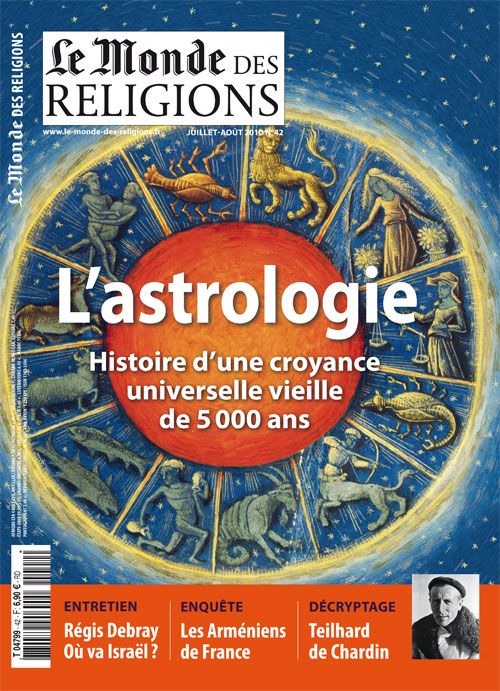
 The World of Religions No. 42, July-August 2010 —
There is reason to be astonished, especially for a skeptic, by the permanence of astrological beliefs and practices across all the cultures of the world. Since the most ancient civilizations, China and Mesopotamia, there has not been a significant cultural area that has not seen astral belief flourish. And while it was believed to be moribund in the West since the 17th century and the rise of scientific astronomy, it seems to have risen from its ashes in recent decades in a dual form: popular (newspaper horoscopes) and cultivated – the psycho-astrology of the astral chart that Edgar Morin does not hesitate to define as a sort of "new science of the subject." In ancient civilizations, astronomy and astrology were confused: the rigorous observation of the celestial vault (astronomy) made it possible to predict events occurring on Earth (astrology). This correspondence between celestial events (eclipses, planetary conjunctions, comets) and terrestrial events (famine, war, death of the king) is the very foundation of astrology. Even if it is based on thousands of years of observations, astrology is not a science, in the modern sense of the term, since its foundation is indemonstrable and its practice subject to a thousand interpretations. It is therefore a symbolic knowledge, which rests on the belief that there is a mysterious correlation between the macrocosm (the cosmos) and the microcosm (society, the individual). In distant Antiquity, its success was due to the need of empires to discern and predict by relying on a higher order, the cosmos. Reading the signs of the sky made it possible to understand the warnings sent by the gods. From a political and religious reading, astrology would evolve over the centuries towards a more individualized and secular reading. In Rome, at the beginning of our era, people would consult an astrologer to find out if a particular medical operation or professional project was appropriate. The modern revival of astrology further reveals the need to know oneself through a symbolic tool, the astral chart, which is supposed to reveal the character of the individual and the broad outlines of their destiny. The original religious belief is evacuated, but not that in destiny, since the individual is supposed to be born at a precise moment when the celestial vault would manifest its potentialities. This law of universal correspondence, which thus makes it possible to connect the cosmos to man, is also the very substrate of what is called esotericism, a sort of multifaceted religious current parallel to the great religions, which has its roots in the West in Stoicism (the soul of the world), Neoplatonism and ancient Hermeticism. The modern need to connect with the cosmos participates in this desire for a "re-enchantment of the world", typical of post-modernity. When astronomy and astrology parted ways in the 17th century, most thinkers were convinced that astrological belief would disappear forever, like an old wives' superstition. A dissenting voice was that of Johannes Kepler, one of the founding fathers of modern astronomical science, who continued to draw astrological charts, explaining that one should not seek to provide a rational explanation for astrology, but should limit oneself to observing its practical effectiveness. Today, it is clear that astrology is not only experiencing a revival in the West, but continues to be practiced in most Asian societies, thus responding to a need as old as humanity: to find meaning and order in such an unpredictable and seemingly chaotic world.
I would like to sincerely thank our friends Emmanuel Leroy Ladurie and Michel Cazenave for all they have contributed through their columns in our newspaper over the years. They are passing the baton to Rémi Brague and Alexandre Jollien, whom we are delighted to welcome.
http://www.youtube.com/watch?v=Yo3UMgqFmDs&feature=player_embedded