
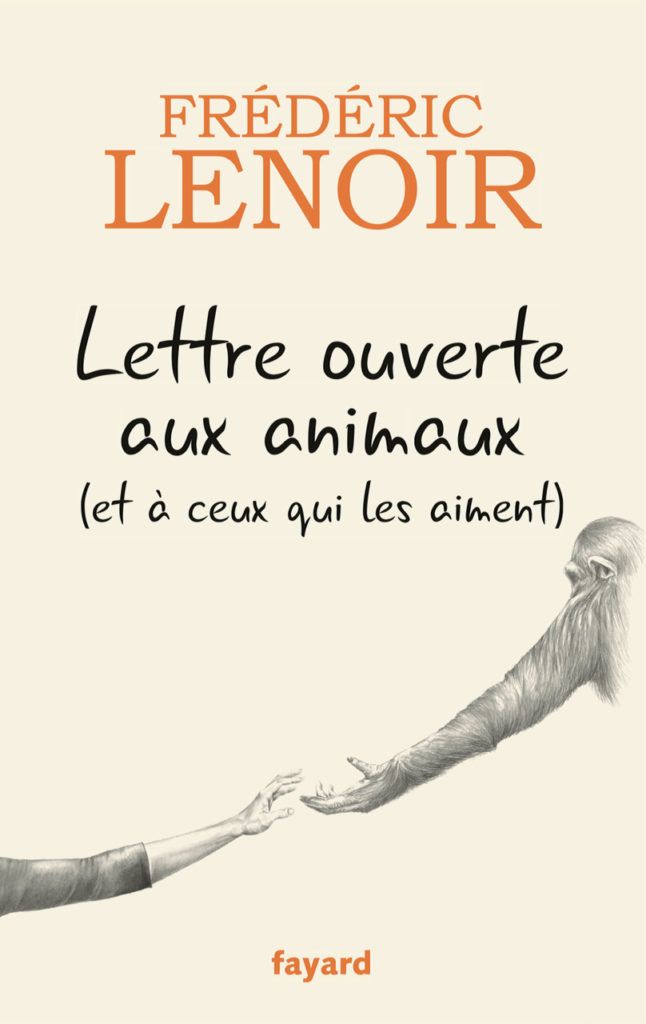
Fayard, May 2017
Table
Opening: Dear animals
- How Homo sapiens became the master of the world
- From domestication to exploitation
- Are you then nothing but things?
- Are we so different?
- Our unique characteristics
- From exploitation to protection
- Beyond the debate on "speciesism"
- What to do?
- A fight for all
- These animals that do us good
- To conclude
Postscript
Notes
Acknowledgments
Bibliography
Opening
Dear (non-human) animals,
How strange human beings must seem to you! You probably see us as just another animal, but you must wonder about the sometimes contradictory nature of our behavior toward you. Why, for example, do we treat dogs and cats with infinite respect in some parts of the world, and why do we mistreat them in others? And why, while we cherish our pets and make countless sacrifices for them, can we, at the same time, devour with relish babies—lambs, calves, piglets—just torn from their mothers' breasts to be taken unceremoniously to the slaughterhouse, when they are just as sentient—and sometimes even as intelligent—as our beloved companions? This is just one of the many manifestations of our moral schizophrenia toward you, and I understand why you find us utterly irrational.
Let me tell you right away, I am not immune to this contradiction. I am neither exemplary nor irreproachable in your eyes, far from it. Since childhood, I have felt a great closeness to you, and I have always feared my fellow humans more than any other land animal! When, barely three or four years old, my parents, trying to dissuade me from wandering to the bottom of the garden in the middle of the night, brandished the threat of thieves who might be prowling there, I would reply: "I know, but the wolves will protect me."
I have always been sensitive to your pain, no doubt as much as to that of my fellow humans. Even today, I cannot bear the sight of bees drowning in a swimming pool, desperately struggling to survive, and I make sure to remove them from the water before diving in. I find it just as difficult to kill or witness the killing of land animals. At just ten years old, I attended my first (and last) bullfight. I have a harrowing memory of it. As soon as the picador, perched on his poor, blinded, harnessed, and terrified horse, began to torture the bull with his lance to weaken it, I understood that the game was rigged; that, in this so-called "noble and fair combat between man and beast," the beast was given no chance and the outcome was almost inevitable. I began to vomit and left the arena. A few years earlier, my father had tried to teach me how to hunt with a bow. I must have been seven or eight years old. He brought me back an African hunting bow, and we went in search of game in the forest. Four magnificent pheasants rose, one after the other, several meters away from us. Standing right behind me, my father shouted, "Shoot, shoot!"... but I was completely incapable of it. How could I decide, for pure pleasure, and not out of necessity, to interrupt life like that? To stop the majestic flight of these birds and transform these beings full of vitality into inert corpses? On the other hand, strangely enough, I've never had any trouble catching fish. A small river bordered the house, and I often fashioned makeshift fishing rods, digging up earthworms (no mercy for them either!) to thread onto the bent needle I'd attached as a hook to the end of a piece of string. I caught many small fish that way, which I killed immediately, not wanting them to suffocate for long, before grilling them over a wood fire. It must be forty years since I last fished, but I remember never feeling the slightest remorse about it, whereas killing a land animal to eat was unthinkable. I can't truly explain this double standard. I am therefore perfectly representative of many of my kind: I am sensitive to your suffering and have long campaigned to alleviate it, but I find it hard to resist a good seafood platter, and even though I have significantly reduced my meat consumption and am moving towards vegetarianism, I still sometimes succumb to a roast chicken at a restaurant or at a friend's house. Nor do I hesitate to squash a mosquito that keeps me awake or to eradicate the moths that are eating holes in my sheep's wool sweaters! Among my kind, your best friends are undoubtedly vegans, who consume nothing that comes from the animal kingdom or its exploitation, but I still feel incapable of adopting this practice, however perfectly consistent it may be. I also wonder, and I will return to this at the end of this letter, whether an ethical attitude towards you can take into account the varying degrees of pain sensitivity and intelligence of your different species, or whether the same absolute respect should be applied to all…
Animal behavior specialists, whom we call "ethologists," have shown us over the past few decades just how much closer we are to you than we long believed. We now know that, like us, you are sensitive to pain. Like us, you can possess logical, deductive intelligence, capable of distinguishing, and sometimes even naming. You use forms of language. You sometimes know how to make tools and pass on customs to your offspring. You may joke and you love to play. You show love and often even compassion. Some of you are self-aware and demonstrate a well-developed sense of morality and justice—yours, not ours. Of course, there are also differences between us and you, just as there are differences between species. Each one is unique… just like all the others. What makes us unique—the complexity of our language, the boundless nature of our desires, our mythico-religious thinking, our capacity to project ourselves into the distant future, and our universal moral conscience—should encourage us to adopt a just and responsible attitude toward you. And yet, we are most often driven by the most foolish instinct to dominate and exploit you, according to the old adage of the law of the strongest. Of course, we cloak this predatory and domineering instinct in a thousand intellectual and rhetorical artifices. For one of the unique characteristics of humankind is precisely this extraordinary capacity to justify its desires! As the philosopher Baruch Spinoza pointed out in the 17th century: “We do not desire something because we judge it to be good, but we judge it to be good because we desire it.” It suits us to exploit a donkey, to witness the killing of a bull in an arena, or to eat suckling pig… So be it! Let's invent good reasons – economic, cultural, biological, gastronomic or religious – to do it, in order to satisfy our desire… with a clear conscience.
Just as we cannot think for you, you cannot understand what goes on in our minds. That is why I will try to explain to you the vision we have of you and of ourselves. I would like to tell you the long history of the bond that unites us and the justifications we have found for dominating you, exploiting you, and killing you en masse today. I will also speak to you of the human beings who have always refused, and who continue to refuse, this exploitation and this mass slaughter. Finally, I will tell you what solutions we humans, who are the most powerful species and therefore, morally, the most responsible, can consider in order to better respect you, dear animals, you who cannot express in our words what you feel. I will also punctuate these lines with quotations from some of your most eloquent friends—writers, philosophers, scientists, poets—who know that a human being can only grow in humanity by being as respectful as possible of all sentient beings inhabiting the Earth.