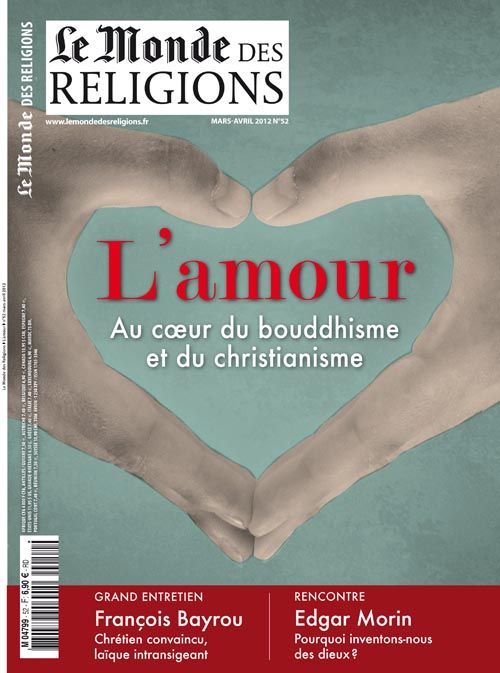
 Le Monde des religions no. 52 – March/April 2012 —
The question of how French people vote according to their religion is very rarely addressed. Even though, by virtue of the principle of secularism, religious affiliation has not been requested in censuses since the beginning of the Third Republic, we do have opinion polls that provide some information on this subject. Due to their limited sample size, however, these polls cannot measure religions that are too small a minority, such as Judaism, Protestantism, or Buddhism, each of which has fewer than one million adherents. We can, however, get a clear picture of the voting patterns of those who identify as Catholic (approximately 60% of the French population, including 25% practicing Catholics) and Muslim (approximately 5%), as well as those who declare themselves "without religion" (approximately 30% of the French population). A Sofres/Pèlerin Magazine poll conducted last January confirms the historical right-wing leanings of French Catholics. In the first round, 33% of them would vote for Nicolas Sarkozy, and this figure rises to 44% among practicing Catholics. 21% would also vote for Marine Le Pen, but this figure is lower than the national average among practicing Catholics (18%). In the second round, 53% of Catholics would vote for Nicolas Sarkozy compared to 47% for François Hollande, and 67% of practicing Catholics would vote for the right-wing candidate – and even 75% for regular churchgoers.
This poll also reveals that while Catholics align with the average French voter in prioritizing job security and purchasing power, they are less concerned than others about reducing inequality and poverty… but more concerned about fighting crime. Ultimately, faith and evangelical values carry less weight in the political vote of the majority of Catholics than economic or security concerns. It hardly matters, in fact, whether the candidate is Catholic or not. It is striking to note that the only major presidential candidate who openly declares his Catholic practice, François Bayrou, is not garnering any more votes among Catholics than among the rest of the population. Most French Catholics, and especially practicing ones, are primarily attached to a value system based on order and stability. However, François Bayrou holds a progressive viewpoint on various social issues with fundamental ethical implications. This is likely to unsettle a significant portion of the traditional Catholic electorate. Nicolas Sarkozy has undoubtedly sensed this, as he remains consistent with traditional Catholic positions on bioethics laws, same-sex parenting, and same-sex marriage.
Finally, surveys conducted by the Sciences Po Center for Political Research show that French Muslims, unlike Catholics, vote overwhelmingly for left-wing parties (78%). Even though three-quarters of them hold low-skilled jobs, a voting pattern specifically linked to religion is evident, with 48% of Muslim workers and employees identifying as left-leaning, compared to 26% of Catholic workers and employees and 36% of workers and employees with no religion. The "non-religious" population as a whole—a category that continues to grow—also votes strongly for the left (71%). This reveals a strange alliance between the "non-religious"—most often progressive on social issues—and French Muslims, who are undoubtedly more conservative on these same issues but committed to a "anything but Sarkozy" mentality.