
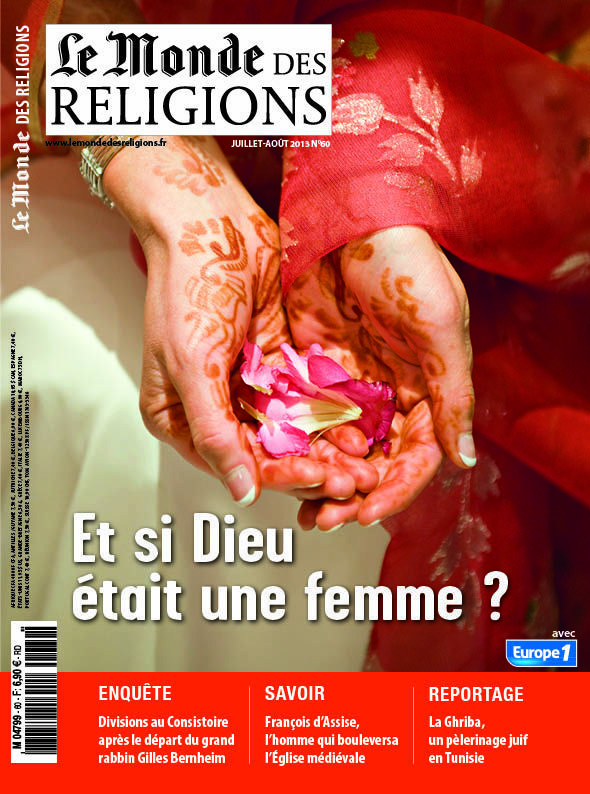
 The World of Religions No. 60 – July/August 2013 –
A Jewish story tells that God actually created Eve before Adam. Since Eve was bored in paradise, she asked God to give her a companion. After careful consideration, God finally granted her request: “Very well, I will create man. But be careful, he is very sensitive: never tell him that you were created before him, he would take it very badly. Let this remain a secret between us… between women!”
If God exists, it is quite clear that he is not gendered. One might then ask why most major religions have presented him as an exclusively male being. As this issue's feature reminds us, this was not always the case. The worship of the Great Goddess undoubtedly preceded that of "Yahweh, Lord of Hosts ," and goddesses occupied a prominent place in the pantheons of early civilizations. The masculinization of the clergy is undoubtedly one of the main reasons for this reversal, which took place over the three millennia preceding our era: how could a city and a religion governed by men venerate a supreme deity of the opposite sex? With the development of patriarchal societies, the matter was settled: the supreme god, or the one god, could no longer be conceived as feminine. This applied not only to his representation, but also to his character and function: his attributes of strength, domination, and power were valued. In heaven as on earth, the world is governed by a dominant male.
Even though the feminine aspect of the divine persists within religions through various mystical or esoteric currents, it is only in the modern era that this hyper-masculinization of God is truly challenged. Not that we are witnessing a shift from a masculine to a feminine representation of the divine. Rather, we are seeing a rebalancing. God is no longer primarily perceived as a formidable judge, but above all as good and merciful; believers are increasingly coming to believe in his benevolent providence. One could say that the typically "paternal" figure of God is tending to fade in favor of a more typically "maternal" representation. Similarly, sensitivity, emotion, and fragility are valued in the spiritual experience. This evolution is obviously linked to the revaluation of women in our modern societies, which is increasingly affecting religions, notably by allowing women to access teaching and leadership positions within religious services. It also reflects the recognition, in our modern societies, of qualities and values identified as more "typically" feminine, even though they obviously concern men as much as women: compassion, openness, welcoming, and the protection of life. Faced with the alarming resurgence of machismo in religious fundamentalism of all stripes, I am convinced that this revaluation of women and this feminization of the divine constitute the main key to a true spiritual renewal within religions. Undoubtedly, woman is the future of God.
I am taking this opportunity to pay tribute to two women well known to our loyal readers. Jennifer Schwarz, former editor-in-chief of your magazine, is embarking on new adventures. I thank her from the bottom of my heart for the enthusiasm and generosity with which she dedicated herself to this role for over five years. I also extend a warm welcome to her successor, Virginie Larousse. Ms. Larousse previously directed an academic journal on religions and taught the history of religions at the University of Burgundy. She has been a contributor to Le Monde des Religions .