

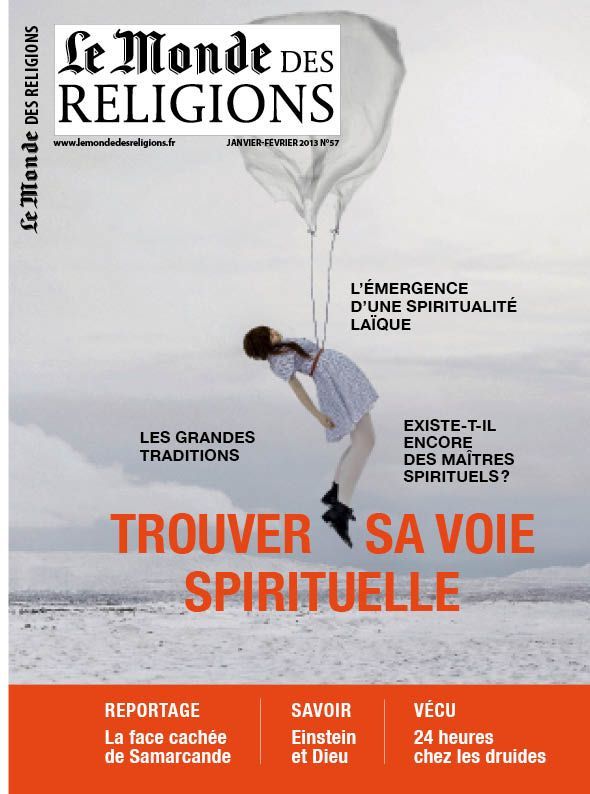
 The World of Religions No. 57 – January/February 2013 –
Is the idea that each individual can "find their spiritual path" truly modern? Yes and no. In the East, during the time of the Buddha, we find many seekers of the Absolute searching for a personal path to liberation. In ancient Greece and Rome, mystery cults and numerous philosophical schools—from the Pythagoreans to the Neoplatonists, including the Stoics and Epicureans—offered many initiatory paths and paths to wisdom for individuals seeking a good life. The subsequent development of major civilizations, each founded on a religion that gave meaning to individual and collective life, would limit the spiritual offerings. Nevertheless, within each major tradition, we will always find diverse spiritual currents, responding to a certain diversity of individual expectations. Thus, in Christianity, the many religious orders offer a fairly wide variety of spiritual sensibilities: from the most contemplative, such as the Carthusians or the Carmelites, to the most intellectual, such as the Dominicans or the Jesuits, or even those emphasizing poverty (Franciscans), the balance between work and prayer (Benedictines) or charitable action (brothers and sisters of Saint Vincent de Paul, missionaries of charity).
Beyond those involved in religious life, lay associations developed from the late Middle Ages onward, most often within the sphere of influence of the major religious orders, even if these were not always well-regarded by the institution, as evidenced by the persecution suffered by the Beguines. The same phenomenon can be found in Islam with the development of numerous Sufi brotherhoods, some of which were also persecuted. Jewish mystical sensibility found expression in the birth of Kabbalah, and a great diversity of spiritual schools and movements continued to exist in Asia. Modernity brought two new elements: the decline of collective religion and the blending of cultures. This led to new spiritual syncretisms linked to the personal aspirations of each individual in search of meaning, and to the development of a secular spirituality that expresses itself outside of any religious belief or practice. This situation is not entirely unprecedented, as it is reminiscent of that of Roman Antiquity, but the mixing of cultures is much more intense (everyone today has access to the entire spiritual heritage of humanity), and we are also witnessing a true democratization of the spiritual quest which no longer simply concerns a social elite.
But through all these transformations, one essential question remains: must each individual seek, and can they find, the spiritual path that allows them to fulfill themselves to the fullest? My answer is undoubtedly yes. Yesterday, as today, the spiritual path is the fruit of a personal journey, and this journey is more likely to succeed if each person seeks a path that is suited to their sensitivity, their abilities, their ambition, their desires, and their questions. Of course, some individuals find themselves lost in the face of the vast array of paths available to us today. "What is the best spiritual path?" the Dalai Lama was once asked. The Tibetan leader's reply: "The one that makes you a better person." This is certainly an excellent criterion for discernment.
http://www.lemondedesreligions.fr/mensuel/2013/57/