
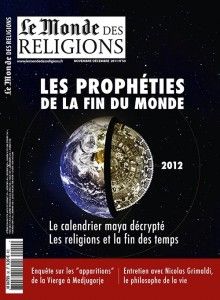
 The World of Religions No. 50 – November/December 2011 —
Will the world end on December 21, 2012? For a long time, I paid no attention to the famous prophecy attributed to the Mayans. But in recent months, many people have asked me about it, often assuring me that their teenagers are anxious because of the information they read on the internet or affected by 2012, the Hollywood disaster film. Is the Mayan prophecy authentic? Are there other religious prophecies of the imminent end of the world, as one can read online? What do religions say about the end times? The feature in this issue answers these questions. But the success of this rumor surrounding December 21, 2012, raises another: how can we explain the anxiety of many of our contemporaries, most of whom are not religious, and for whom such a rumor seems plausible? I see two explanations.
First, we are living through a particularly distressing era, where humanity feels as if it is aboard a runaway train. Indeed, no institution, no state seems capable of halting the headlong rush toward the unknown—and perhaps the abyss—into which consumerist ideology and economic globalization under the aegis of neoliberal capitalism are propelling us: dramatic increases in inequality; ecological catastrophes threatening the entire planet; uncontrolled financial speculation that is weakening the entire global economy. Then there are the upheavals in our lifestyles that have turned Westerners into uprooted amnesiacs, equally incapable of projecting themselves into the future. Our lifestyles have undoubtedly changed more in the last century than they had in the previous three or four millennia. The European of the past lived predominantly in the countryside, observing nature, rooted in a slow-paced, close-knit rural world and steeped in age-old traditions. The same was true for people in the Middle Ages and Antiquity. Today's European is overwhelmingly urban; they feel connected to the entire planet, but lack strong local ties; they lead an individualistic existence at a frenetic pace and have often severed themselves from the age-old traditions of their ancestors. We must perhaps go back to the Neolithic period (around 10,000 BCE in the Near East and around 3,000 BCE in Europe), when humans abandoned a nomadic hunter-gatherer lifestyle and settled in villages, developing agriculture and animal husbandry, to find a revolution as radical as the one we are currently experiencing. This has profound consequences for our psyche. The speed with which this revolution has occurred generates uncertainty, a loss of fundamental reference points, and the weakening of social bonds. It is a source of worry, anxiety, and a confused sense of fragility for both individuals and human communities, leading to heightened sensitivity to themes of destruction, disintegration, and annihilation.
One thing seems certain to me: we are not experiencing the symptoms of the end of the world, but the end of a world. The world of the traditional, millennia-old world I just described, with all its associated thought patterns, but also the ultra-individualistic and consumerist world that succeeded it, in which we are still immersed, which is showing so many signs of exhaustion and revealing its true limitations for genuine progress of humanity and societies. Bergson said that we would need a "supplement of soul" to face the new challenges. Indeed, we can see in this profound crisis not only a series of predicted ecological, economic, and social catastrophes, but also the chance for a resurgence, a humanist and spiritual renewal, through an awakening of consciousness and a sharper sense of individual and collective responsibility.