
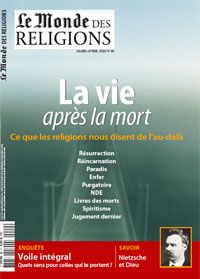
 Le Monde des religions no. 40, March-April 2010 —
Benedict XVI's decision to continue the beatification process of Pope Pius XII has sparked widespread controversy, dividing both the Jewish and Christian worlds. The president of the rabbinical community of Rome boycotted the Pope's visit to the Great Synagogue of Rome in protest against Pius XII's "passive" attitude toward the tragedy of the Holocaust.
Benedict XVI once again justified the decision to canonize his predecessor, arguing that he could not more openly condemn the atrocities committed by the Nazi regime without risking reprisals against Catholics, of whom the many Jews hiding in convents would have been the first victims. The argument is entirely sound. The historian Léon Poliakov had already emphasized this point in 1951, in the first edition of *The Breviary of Hatred: The Third Reich and the Jews*: “It is painful to note that throughout the war, while the death factories operated at full tilt, the papacy remained silent. However, it must be acknowledged that, as experience has shown on a local level, public protests could be immediately followed by ruthless sanctions.”
Pius XII, ever the skilled diplomat, tried to have his cake and eat it too: he secretly supported the Jews, directly saving the lives of thousands of Roman Jews after the German occupation of Northern Italy, while simultaneously avoiding a direct condemnation of the Holocaust, so as not to break off all dialogue with the Nazi regime and to prevent a brutal reaction. This stance can be described as responsible, rational, prudent, even wise. But it is not prophetic and does not reflect the actions of a saint. Jesus died on the cross for having remained faithful to the very end to his message of love and truth.
Following in his footsteps, the apostles Peter and Paul gave their lives because they refused to renounce proclaiming Christ's message or adapting it to circumstances for "diplomatic reasons." Imagine if they had been popes instead of Pius XII? It's hard to imagine them compromising with the Nazi regime, but rather choosing to die deported alongside millions of innocent people. This is the act of holiness, of prophetic significance, that, in such tragic historical circumstances, one could expect from Peter's successor. A pope who gives his life and says to Hitler: "I would rather die with my Jewish brothers than condone this abomination."
Certainly, the reprisals would have been terrible for Catholics, but the Church would have sent an incredibly powerful message to the entire world. The first Christians were saints because they placed their faith and love of neighbor above their own lives. Pius XII will be canonized because he was a pious man, a good administrator of the Roman Curia, and a skilled diplomat. This is the fundamental difference between the Church of the martyrs and the post-Constantinian Church, more concerned with preserving its political influence than with bearing witness to the Gospel.