
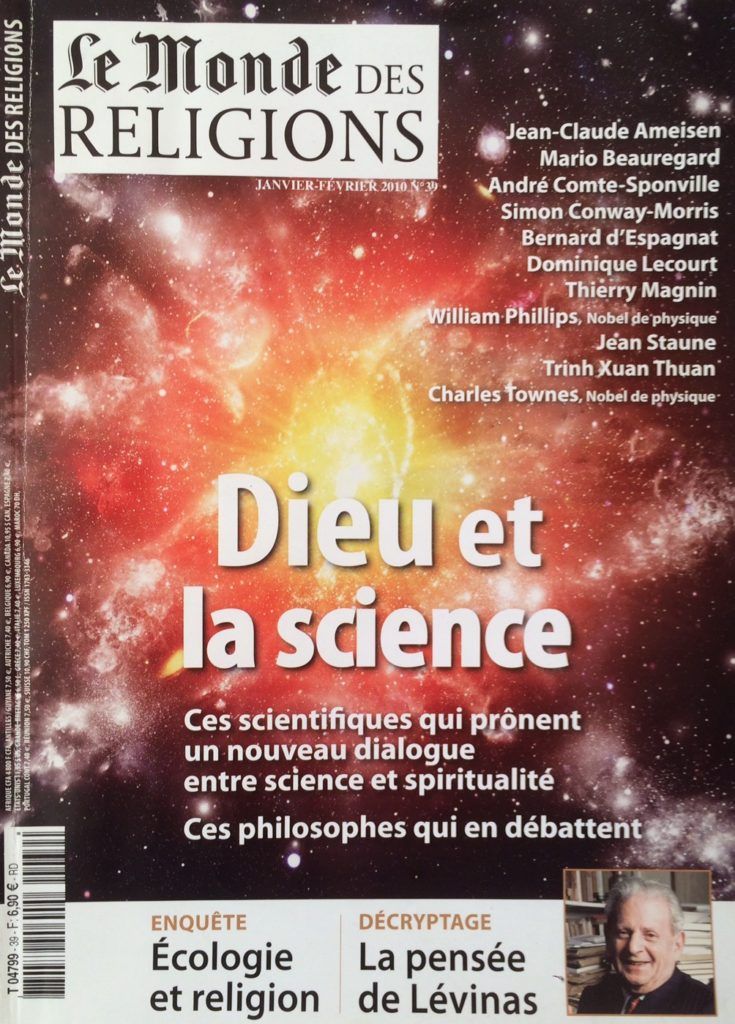
 Le Monde des religions no. 39, January-February 2010 —
Nearly four centuries after Galileo's condemnation, the public debate on science and religion still seems polarized by two extremes. On one side, creationist fervor, which seeks to deny certain undeniable scientific findings in the name of a fundamentalist interpretation of the Bible. On the other, the media attention given to the works of certain scientists, such as Richard Dawkins ( The God Delusion , Robert Laffont, 2008), who claim to prove God's non-existence using scientific arguments. Yet, these positions remain quite marginal in both camps. In the West, a large majority of believers accept the legitimacy of science, and most scientists maintain that science will never be able to prove the existence or non-existence of God. Ultimately, and to borrow a phrase from Galileo himself, it is accepted that science and religion address two radically different questions, which cannot be in conflict: "The intention of the Holy Spirit is to teach us how to go to heaven, not how heaven goes." In the 18th century, Kant reiterated the distinction between faith and reason, and the impossibility for pure reason to answer the question of God's existence. Born in the second half of the 19th century, scientism nevertheless became a veritable "religion of reason," repeatedly proclaiming the death of God thanks to the victories of science. Richard Dawkins is one of its latest incarnations. Creationism also emerged in the second half of the 19th century, as a reaction to Darwin's theory of evolution. Its fundamentalist biblical version was succeeded by a much milder version, which accepts the theory of evolution but seeks to prove God's existence through science via the theory of intelligent design . A more audible thesis, but one that falls back into the rut of confusing scientific and religious approaches.
If we accept this distinction between different kinds of knowledge, which seems to me to be a fundamental tenet of philosophical thought, must we therefore assert that no dialogue is possible between science and religion? And more broadly, between a scientific vision and a spiritual conception of man and the world?
This issue's dossier gives voice to internationally renowned scientists who call for such a dialogue. Indeed, it is not so much religious figures as scientists who are increasingly advocating for a new dialogue between science and spirituality. This is largely due to the evolution of science itself over the last century. Starting with the study of the infinitely small (the subatomic world), theories of quantum mechanics have shown that material reality is far more complex, profound, and mysterious than could be imagined according to the models of classical physics inherited from Newton. At the other extreme, that of the infinitely large, discoveries in astrophysics concerning the origins of the universe, and in particular the Big Bang theory, have swept away the theories of an eternal and static universe, on which many scientists relied to assert the impossibility of a creative principle. To a lesser extent, research on the evolution of life and consciousness is now tending to challenge the scientistic views of "chance explaining everything" and "neuronal man." In the first part of this dossier, scientists share both the facts—what has changed in science over the past century—and their own philosophical opinions: why science and spirituality can engage in fruitful dialogue while respecting their respective methods. Going even further, other researchers, including two Nobel laureates, then offer their own perspectives as scientists and believers, explaining why they believe that science and religion, far from being opposed, tend to converge. The third part of the dossier gives the floor to philosophers: what do they think of this new scientific paradigm and the discourse of these researchers who advocate a new dialogue, or even a convergence, between science and spirituality? What are the methodological perspectives and limitations of such a dialogue? Beyond sterile and emotional controversies, or, conversely, superficial reconciliations, these are questions and debates that seem essential to a better understanding of the world and ourselves.