
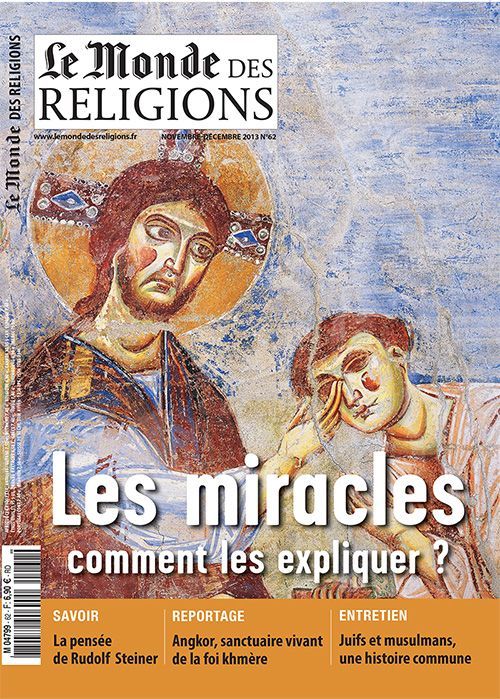
 The World of Religions No. 62 – Nov/December 2013 –
On the subject of miracles, I know of no text as profound and illuminating as the reflection Spinoza offers us in chapter 6 of his Theological-Political Treatise. "Just as men call divine any science that surpasses the reach of the human mind, they see the hand of God in every phenomenon whose cause is generally unknown," writes the Dutch philosopher. Now, God cannot act outside the laws of nature that he himself established. If unexplained phenomena exist, these never contradict natural laws, but they appear to us as "miraculous" or "prodigious" because our knowledge of the complex laws of nature is still limited. Spinoza thus explains that the prodigies recounted in Scripture are either legendary or the result of natural causes that surpass our understanding: such is the case with the Red Sea, which is said to have parted under the effect of a violent wind, or with the healings of Jesus, which mobilize as yet unknown resources of the human body or mind. The philosopher then engages in a political deconstruction of the belief in miracles and denounces the "arrogance" of those who intend to demonstrate that their religion or nation "is dearer to God than all others." He sees belief in miracles, understood as supernatural phenomena, not only as a "stupidity" contrary to reason, but also as contrary to true faith, and one that undermines it: "If, therefore, a phenomenon were to occur in nature that was not in accordance with its laws, one would necessarily have to admit that it is contrary to them and that it overturns the order that God established in the universe by giving it general laws to regulate it eternally. From this, one must conclude that belief in miracles should lead to universal doubt and atheism."
It is with a heavy heart that I write this editorial, as it is my last. Indeed, it has been almost ten years since I took the helm of Le Monde des Religions. The time has come to hand over the reins and devote all my time to my personal projects: books, plays, and soon, I hope, a film. I have had immense joy in this exceptional publishing adventure and thank you from the bottom of my heart for your loyalty, which has allowed this journal to become a true authority on religious affairs throughout the French-speaking world (it is distributed in sixteen French-speaking countries). I sincerely hope that you will continue to support it, and I am pleased to entrust its leadership to Virginie Larousse, the editor-in-chief, who has an excellent knowledge of religions and solid journalistic experience. She will be assisted in her task by an editorial committee comprised of several familiar faces. We are working together on a new format, which you will discover in January, and which she herself will present in the next issue.
Wishing everyone all the best for the future.
Read articles online from Le Monde des Religions: www.lemondedesreligions.fr