
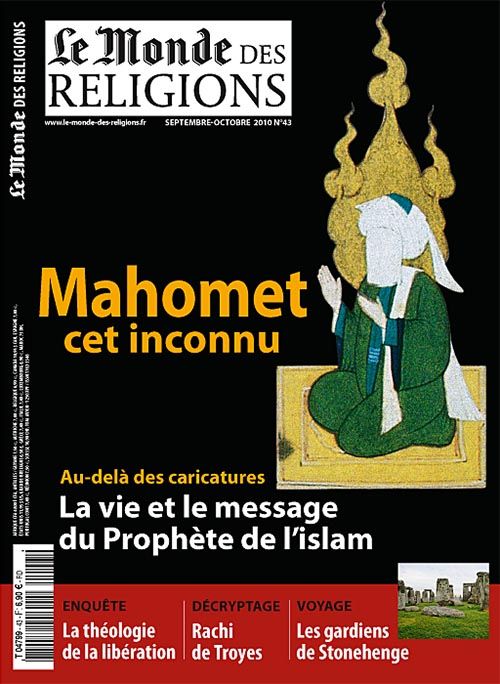
 Le Monde des religions no. 43, September-October 2010 —
In his latest essay*, Jean-Pierre Denis, editor-in-chief of the Christian weekly La Vie , shows how, over the past few decades, the libertarian counterculture that emerged from May '68 has become the dominant culture, while Christianity has become a peripheral counterculture. The analysis is insightful, and the author eloquently argues for a "Christianity of objection" that is neither conquering nor defensive. Reading this work inspires a few reflections, beginning with a question that will strike many readers as provocative, to say the least: has our world ever been Christian? That there has been a so-called "Christian" culture, marked by the beliefs, symbols, and rituals of the Christian religion, is undeniable. That this culture has profoundly permeated our civilization, to the point that even secularized societies remain imbued with an omnipresent Christian heritage—calendar, holidays, buildings, artistic heritage, popular expressions, etc.—is indisputable. But what historians call "Christendom"—that thousand-year period stretching from the end of Antiquity to the Renaissance, marking the convergence of the Christian religion and European societies—was it ever truly Christian in its deepest sense, that is, faithful to the message of Christ? For Søren Kierkegaard, a fervent and tormented Christian thinker, "all of Christendom is nothing more than humanity's effort to get back on its feet, to rid itself of Christianity ." What the Danish philosopher aptly emphasizes is that the message of Jesus is utterly subversive with regard to morality, power, and religion, since it places love and powerlessness above all else. So much so that Christians quickly adapted it to the human spirit by reframing it within a framework of traditional religious thought and practices. The birth of this "Christian religion," and its incredible perversion from the 4th century onward in its conflation with political power, is often diametrically opposed to the message that inspires it. The Church is necessary as a community of disciples whose mission is to transmit the memory of Jesus and his presence through the only sacrament he instituted (the Eucharist), to spread his word, and above all, to bear witness to it. But how can one recognize the Gospel message in canon law, pompous decorum, narrow moralism, the pyramidal ecclesiastical hierarchy, the proliferation of sacraments, the bloody struggle against heresies, and the clergy's hold on society with all the abuses that this entails? Christendom is the sublime beauty of cathedrals, but it is also all of this. Acknowledging the end of our Christian civilization, a father of the Second Vatican Council exclaimed: "Christendom is dead, long live Christianity!" “ Paul Ricoeur, who recounted this anecdote to me a few years before his death, added: ‘I would rather say: Christianity is dead, long live the Gospel!, since there has never been an authentically Christian society.’ Ultimately, doesn’t the decline of the Christian religion present an opportunity for Christ’s message to be heard again? ‘You cannot put new wine into old wineskins ,’ said Jesus. The profound crisis of the Christian churches is perhaps the prelude to a new renaissance of the living faith of the Gospels. A faith which, because it refers to love of neighbor as a sign of God’s love, is not without a strong affinity with the secular humanism of human rights that constitutes the foundation of our modern values. And a faith which will also be a fierce force of resistance against the materialistic and mercantile impulses of an increasingly dehumanized world.” A new face of Christianity can therefore emerge on the ruins of our "Christian civilization", of which believers attached to the gospel more than to Christian culture and tradition will have no nostalgia.
* Why Christianity Causes Scandal (Seuil, 2010).