
Editorials World of Religions
Listed in descending chronological order: from most recent (Nov-Dec 2013) to oldest (Nov-Dec 2004)
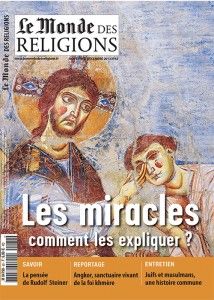
Le Monde des Religions No. 62 – Nov/Dec 2013 – On the question of miracles, I know of no text as profound and illuminating as the reflection Spinoza offers us in Chapter 6 of his Theological-Political Treatise. “Just as men call divine any science that surpasses the reach of the human mind, they see the hand of God in every phenomenon whose cause is generally unknown,” writes the Dutch philosopher. Now, God cannot act outside the laws of nature that he himself established. If unexplained phenomena exist, these never contradict natural laws, but they appear to us as “miraculous” or “prodigious” because our knowledge of the complex laws of nature is still limited. Spinoza explains that the prodigies recounted in Scripture are either legendary or the result of natural causes that surpass our understanding: this is the case with the Red Sea, which is said to have parted under the effect of a violent wind, or with the healings of Jesus, which supposedly mobilized previously unknown resources of the human body or mind. The philosopher then undertakes a political deconstruction of the belief in miracles and denounces the "arrogance" of those who intend to demonstrate that their religion or nation "is dearer to God than all others." Not only does the belief in miracles, understood as supernatural phenomena, appear to him as a "stupidity" contrary to reason, but also contrary to true faith, and one that undermines it: "If, therefore, a phenomenon were to occur in nature that was not in accordance with its laws, it would necessarily have to be admitted that it is contrary to them and that it overturns the order that God established in the universe by giving it general laws to regulate it eternally." From this, we must conclude that belief in miracles should lead to universal doubt and atheism.” It is with a touch of emotion that I write this editorial, for it is my last. Indeed, it has been almost ten years since I began directing Le Monde des Religions. The time has come to hand over the reins and devote all my time to my personal projects: books, plays, and soon, I hope, a film. I have had great joy in this exceptional publishing adventure and thank you from the bottom of my heart for your loyalty, which has allowed this journal to become a true reference on religious affairs throughout the French-speaking world (it is distributed in sixteen French-speaking countries). I sincerely hope that you will continue to support it, and I am happy to entrust its leadership to Virginie Larousse, the editor-in-chief, who has an excellent knowledge of religions and solid journalistic experience. She will be assisted in her task by an editorial committee comprised of several familiar faces. We are working together on a new format that you will discover in January, and which she will present herself in the next issue. All the best to everyone. Read articles online from Le Monde des Religions: www.lemondedesreligions.fr [...]

The World of Religions No. 61 – Sept/October 2013 – As Saint Augustine wrote in On the Happy Life: “The desire for happiness is essential to man; it is the motive of all our actions. The most venerable, most understood, most clarified, most constant thing in the world is not only that we want to be happy, but that we want to be nothing but that. This is what our nature compels us to do.” While every human being aspires to happiness, the question is whether profound and lasting happiness can exist here on earth. Religions offer very divergent answers to this question. The two most opposing positions, it seems to me, are those of Buddhism and Christianity. While the entire doctrine of the Buddha rests on the pursuit of a state of perfect serenity here and now, that of Christ promises the faithful true happiness in the afterlife. This stems from the life of its founder – Jesus died tragically around the age of 36 – but also from his message: the Kingdom of God he proclaimed is not an earthly kingdom but a heavenly one, and blessedness is yet to come: “Blessed are those who mourn, for they will be comforted” (Matthew 5:5). In an ancient world rather inclined to seek happiness here and now, including within Judaism, Jesus clearly shifts the focus of happiness to the afterlife. This hope for heavenly paradise would permeate the history of Western Christianity and sometimes lead to many forms of extremism: radical asceticism and the desire for martyrdom, mortifications and suffering sought in pursuit of the heavenly Kingdom. But with Voltaire's famous phrase – “Paradise is where I am” – a remarkable shift in perspective took place in Europe from the 18th century onward: paradise was no longer to be awaited in the afterlife but realized on Earth, through reason and human effort. Belief in the afterlife—and therefore in a paradise in heaven—will gradually diminish, and the vast majority of our contemporaries will seek happiness here and now. Christian preaching is completely transformed as a result. After having so emphasized the torments of hell and the joys of paradise, Catholic and Protestant preachers now hardly speak of the afterlife. The most popular Christian movements—Evangelicals and Charismatics—have fully embraced this new reality and constantly affirm that faith in Jesus brings the greatest happiness, right here on Earth. And since many of our contemporaries equate happiness with wealth, some even go so far as to promise the faithful "economic prosperity" on Earth, thanks to faith. We are very far from Jesus, who declared that “it is easier for a camel to go through the eye of a needle than for a rich man to enter the kingdom of God” (Matthew 19:24)! The profound truth of Christianity undoubtedly lies between these two extremes: the rejection of life and morbid asceticism—rightly denounced by Nietzsche—in the name of eternal life or the fear of hell on the one hand; the sole pursuit of earthly happiness on the other. Jesus, in essence, did not despise the pleasures of this life and practiced no “mortification”: he loved to drink, eat, and share with his friends. We often see him “leaping for joy.” But he clearly stated that supreme beatitude is not to be found in this life. He does not reject earthly happiness, but places other values before it: love, justice, and truth. He thus demonstrates that one can sacrifice earthly happiness and give one's life out of love, to fight against injustice, or to remain faithful to the truth. The contemporary testimonies of Gandhi, Martin Luther King, and Nelson Mandela are powerful examples of this. The question remains: will the gift of their lives find just reward in the afterlife? This is the promise of Christ and the hope of billions of believers worldwide. Read the articles online from Le Monde des Religions: www.lemondedesreligions.fr [...]
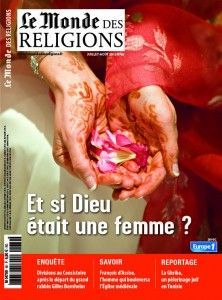
The World of Religions No. 60 – July/August 2013 – A Jewish story recounts that God actually created Eve before Adam. As Eve grew bored in paradise, she asked God to give her a companion. After careful consideration, God finally granted her request: “Very well, I will create man. But be careful, he is very sensitive: never tell him that you were created before him, he would take it very badly. Let this remain a secret between us… between women!” If God exists, it is quite clear that he is not gendered. One might therefore wonder why most major religions have created an exclusively male representation of him. As the feature in this issue reminds us, this was not always the case. The worship of the Great Goddess undoubtedly preceded that of “Yahweh, Lord of Hosts,” and goddesses occupied a prominent place in the pantheons of early civilizations. The masculinization of the clergy is undoubtedly one of the main reasons for this reversal, which took place over the three millennia preceding our era: how could a city and a religion governed by men venerate a supreme deity of the opposite sex? With the development of patriarchal societies, the matter was settled: the supreme god, or the one god, could no longer be conceived as feminine. This was true not only in his representation, but also in his character and function: his attributes of strength, domination, and power were valued. In heaven as on earth, the world was governed by a dominant male. Even if the feminine character of the divine persisted within religions through various mystical or esoteric currents, it was only in the modern era that this hypermasculinization of God was truly challenged. Not that we moved from a masculine to a feminine representation of the divine. Rather, we witnessed a rebalancing. God is no longer primarily perceived as a formidable judge, but above all as good and merciful; believers are increasingly placing their faith in his benevolent providence. One could say that the typically "paternal" figure of God is tending to fade in favor of a more typically "maternal" representation. Similarly, sensitivity, emotion, and fragility are valued in spiritual experience. This evolution is clearly linked to the revaluation of women in our modern societies, which is increasingly impacting religions, notably by allowing women to access teaching and leadership positions in worship. It also reflects the recognition, in our modern societies, of qualities and values identified as more "typically" feminine, even if they obviously concern men as much as women: compassion, openness, welcoming, and the protection of life. Faced with the alarming resurgence of machismo among religious fundamentalists of all stripes, I am convinced that this revaluation of women and this feminization of the divine constitute the main key to a true spiritual renewal within religions. Undoubtedly, woman is the future of God. I take this opportunity to salute two women well known to our loyal readers. Jennifer Schwarz, former editor-in-chief of your magazine, is embarking on new adventures. I thank her from the bottom of my heart for the enthusiasm and generosity with which she dedicated herself to her role for over five years. I also warmly welcome her successor: Virginie Larousse. Ms. Larousse directed an academic journal devoted to religions for many years and taught the history of religions at the University of Burgundy. She has been a contributor to Le Monde des Religions for many years. [...]
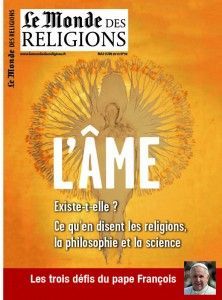
Le Monde des Religions No. 59 – May/June 2013 – Invited to comment on the event live on France 2, when I discovered that the new pope was Jorge Mario Bergoglio, my immediate reaction was to say that it was a truly spiritual event. The first time I had heard of the Archbishop of Buenos Aires was about ten years earlier, from Abbé Pierre. During a trip to Argentina, he had been struck by the simplicity of this Jesuit who had left the magnificent episcopal palace to live in a modest apartment and who frequently went alone to the slums. The choice of the name Francis, echoing the Poverello of Assisi, only confirmed that we were about to witness a profound change in the Catholic Church. Not a change in doctrine, nor even probably in morality, but in the very conception of the papacy and in the Church's mode of governance. Introducing himself to the thousands of faithful gathered in St. Peter's Square as "the Bishop of Rome" and asking the crowd to pray for him before praying with them, Francis demonstrated in just a few minutes, through numerous gestures, his intention to return to a humble understanding of his role. This understanding harks back to that of the early Christians, who had not yet made the Bishop of Rome not only the universal head of all Christendom, but also a veritable monarch at the head of a temporal state. Since his election, Francis has multiplied his acts of charity. The question now arises as to how far he will go in the immense task of renewing the Church that awaits him. Will he finally reform the Roman Curia and the Vatican Bank, shaken by scandals for over 30 years? Will he implement a collegial system of governance for the Church? Will he seek to maintain the current status of Vatican City State, a legacy of the former Papal States, which stands in stark contradiction to Jesus' witness of poverty and his rejection of temporal power? How will he also address the challenges of ecumenism and interreligious dialogue, subjects that deeply interest him? And what about evangelization, in a world where the gap between Church discourse and people's lives, especially in the West, continues to widen? One thing is certain: Francis possesses the qualities of heart and intellect, and even the charisma, necessary to bring this great breath of the Gospel to the Catholic world and beyond, as demonstrated by his initial pronouncements in favor of a world peace founded on respect for the diversity of cultures and indeed for all of creation (for perhaps the first time, animals have a pope who cares about them!). The fierce criticism he faced immediately after his election, accusing him of collusion with the former military junta when he was a young superior of the Jesuits, subsided a few days later, particularly after his compatriot and Nobel Peace Prize laureate, Adolfo Pérez Esquivel—imprisoned for 14 months and tortured by the military junta—stated that the new pope, unlike other clergymen, had “no connection with the dictatorship.” Francis is thus enjoying a period of grace that could lead him to take any bold step. Provided, however, that he does not suffer the same fate as John Paul I, who inspired so much hope before dying enigmatically less than a month after his election. Francis is undoubtedly right to ask the faithful to pray for him. www.lemondedesreligions.fr [...]

Le Monde des Religions No. 58 – March/April 2013 – It will undoubtedly seem strange to some of our readers that, following the heated parliamentary debate in France on same-sex marriage, we are devoting a large part of this issue to how religions view homosexuality. Certainly, we address the essential elements of this debate, which also touches on the question of parentage, in the second part of the issue, with the contrasting viewpoints of the Chief Rabbi of France, Gilles Bernheim, the philosophers Olivier Abel and Thibaud Collin, the psychoanalyst and ethnologist Geneviève Delaisi de Parseval, and the sociologist Danièle Hervieu-Léger. But it seems to me that an important question has been largely overlooked until now: what do religions think about homosexuality, and how have they treated homosexuals for centuries? This question was sidestepped by most religious leaders themselves, who immediately placed the debate in the realm of anthropology and psychoanalysis, rather than theology or religious law. The reasons for this become clearer when one examines more closely how homosexuality is vehemently criticized in most sacred texts and how homosexuals are still treated in many parts of the world in the name of religion. For while homosexuality was largely tolerated in antiquity, it is presented as a major perversion in Jewish, Christian, and Muslim scriptures. “If a man lies with a male as with a woman, their deed is an abomination; they shall surely be put to death, and their blood shall be upon them,” it is written in Leviticus (Lev 20:13). The Mishnah says nothing different, and the Church Fathers had no words harsh enough for this practice, which, in the words of Thomas Aquinas, "offends God," since, in his eyes, it violates the very order of nature willed by the Almighty. Under the reigns of the devoutly Christian emperors Theodosius and Justinian, homosexuals were liable to death, suspected of conspiring with the devil and held responsible for natural disasters and epidemics. The Quran, in some thirty verses, condemns this "unnatural" and "outrageous" act, and Sharia law still condemns homosexual men today to punishments that vary from country to country, ranging from imprisonment to hanging, including one hundred lashes. Asian religions are generally more tolerant of homosexuality, but it is condemned by the Vinaya, the monastic code of Buddhist communities, and by certain branches of Hinduism. Even though the positions of Jewish and Christian institutions have softened considerably in recent decades, homosexuality is still considered a crime or offense in about a hundred countries and remains a leading cause of suicide among young people (in France, one in three homosexuals under the age of 20 has attempted suicide due to social rejection). It is this violent discrimination, fueled for millennia by religious arguments, that we also wanted to highlight. The complex and essential debate remains, not only on marriage, but even more so on the family (since the real issue is not the equality of civil rights between same-sex and heterosexual couples, but rather that of parentage and bioethical questions). This debate goes beyond the demands of same-sex couples, as it concerns issues of adoption, medically assisted reproduction, and surrogacy, which can affect heterosexual couples just as much. The government wisely postponed it until the autumn, seeking the opinion of the National Ethics Committee. These are indeed crucial questions that cannot be avoided or resolved with such simplistic arguments as "this is disrupting our societies"—which are, in fact, already disrupted—or, conversely, "it's the inevitable march of the world": any development must be evaluated in light of what is good for humanity and society. http://www.lemondedesreligions.fr/mensuel/2013/58/ [...]
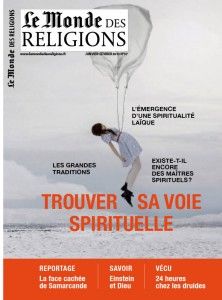
Le Monde des Religions No. 57 – January/February 2013 – Is the idea that each individual can “find their spiritual path” eminently modern? Yes and no. In the East, during the time of the Buddha, we find many seekers of the Absolute who were searching for a personal path to liberation. In Greek and Roman Antiquity, mystery cults and numerous philosophical schools – from the Pythagoreans to the Neoplatonists, including the Stoics and Epicureans – offered many initiatory paths and paths to wisdom for individuals seeking a good life. The subsequent development of major civilizations, each founded on a religion that gave meaning to individual and collective life, limited the spiritual offerings. Nevertheless, within each major tradition, we will always find diverse spiritual currents, responding to a certain diversity of individual expectations. Thus, within Christianity, the numerous religious orders offer a wide variety of spiritual sensibilities: from the most contemplative, such as the Carthusians or Carmelites, to the most intellectual, such as the Dominicans or Jesuits, or those emphasizing poverty (Franciscans), the balance between work and prayer (Benedictines), or charitable action (Brothers and Sisters of Saint Vincent de Paul, Missionaries of Charity). Beyond those committed to religious life, associations of lay people developed from the late Middle Ages onward, most often living within the sphere of influence of the major orders, even if these were not always well-regarded by the institution, as evidenced by the persecution suffered by the Beguines. The same phenomenon can be found in Islam with the development of numerous Sufi brotherhoods, some of which were also persecuted. Jewish mystical sensibility found expression in the birth of Kabbalah, and a great diversity of spiritual schools and movements continued to flourish in Asia. Modernity brought two new elements: the decline of collective religion and the blending of cultures. This led to new spiritual syncretisms linked to the personal aspirations of each individual in search of meaning, and the development of a secular spirituality that expresses itself outside of any religious belief or practice. This situation is not entirely unprecedented, as it is reminiscent of Roman antiquity, but the mixing of cultures is much more intense (everyone today has access to the entire spiritual heritage of humanity), and we are also witnessing a true democratization of the spiritual quest, which is no longer limited to a social elite. But through all these transformations, one essential question remains: should each individual seek, and can they find, the spiritual path that allows them to fulfill themselves to the fullest extent? My answer is undoubtedly: yes. Yesterday, as today, the spiritual path is the fruit of a personal journey, and this journey is more likely to succeed if each person seeks a path suited to their sensitivity, their abilities, their ambition, their desires, and their questions. Of course, some individuals find themselves lost in the face of the vast array of paths available to us today. "What is the best spiritual path?" the Dalai Lama was once asked. The Tibetan leader's reply: "The one that makes you a better person." This is undoubtedly an excellent criterion for discernment. http://www.lemondedesreligions.fr/mensuel/2013/57/ Save [...]

The World of Religions No. 56 – Nov/Dec 2012 – There are the fanatics of God. Those who kill in the name of their religion. From Moses, who commanded the massacre of the Canaanites, to the jihadists of Al-Qaeda, by way of the Catholic Grand Inquisitor, religious fanaticism takes various forms within monotheistic religions, but always stems from the same core identity: killing—or commanding killing—is done to protect the purity of blood or faith, to defend the community (or even a culture, as in the case of Brejvik) against those who threaten it, to extend the religion's hold on society. Religious fanaticism is a dramatic deviation from a biblical and Quranic message that primarily aims to educate human beings to respect others. This is the poison secreted by communitarianism: the feeling of belonging—to the people, to the institution, to the community—becomes more important than the message itself, and “God” is reduced to a mere alibi for self-defense and domination. Religious fanaticism was thoroughly analyzed and denounced by Enlightenment philosophers more than two centuries ago. They fought for freedom of conscience and expression to exist within societies still dominated by religion. Thanks to them, we in the West are free today not only to believe or not to believe, but also to criticize religion and denounce its dangers. But this struggle and this hard-won freedom must not make us forget that these same philosophers aimed to enable everyone to live in harmony within the same political space. Freedom of expression, whether intellectual or artistic, is therefore not intended to attack others solely to provoke or incite conflict. Moreover, John Locke believed, in the name of social peace, that the most virulent atheists should be silenced in public, just like the most intransigent Catholics! What would he say today to those who produce and distribute online a film that is artistically deplorable, attacking what is most sacred to Muslim believers—the figure of the Prophet—for the sole purpose of stirring up tensions between the West and the Islamic world? What would he say to those who add fuel to the fire by publishing new caricatures of Muhammad, in order to sell newspapers, fanning the still-smoldering embers of anger among many Muslims worldwide? And what are the results? Deaths, Christian minorities increasingly threatened in Muslim countries, and heightened tensions throughout the world. The fight for freedom of expression—however noble—does not negate the need for a geopolitical analysis of the situation: extremist groups are exploiting images to rally crowds around a common enemy, a fantasized West reduced to a cinematic fantasy and a few caricatures. We live in an interconnected world subject to numerous tensions that threaten world peace. What Enlightenment philosophers advocated on a national scale is now valid on a global scale: caricatured criticisms whose sole purpose is to offend believers and provoke the most extremist among them are foolish and dangerous. Their main effect is to strengthen the camp of religious fanatics and undermine the efforts of those trying to establish a constructive dialogue between cultures and religions. Freedom implies responsibility and concern for the common good. Without these, no society is viable. http://www.lemondedesreligions.fr/mensuel/2012/56/ Save [...]

The World of Religions No. 55 – September/October 2012 — Some thirty years ago, when I began my studies in the sociology and history of religions, the only topic of conversation was "secularization," and most specialists in religious studies believed that religion would gradually transform and then dissolve within European societies increasingly marked by materialism and individualism. The European model would then spread to the rest of the world with the globalization of Western values and lifestyles. In short, religion was doomed in the more or less long term. For the past ten years or so, the model and the analysis have been reversed: we speak of "desecularization," we see the rise of identity-based and conservative religious movements everywhere, and Peter Berger, the great American sociologist of religion, observes that "the world is still as furiously religious as it has always been." Europe is thus perceived as a global exception, but one that risks being increasingly affected by this new religious wave. So, what scenario for the future? Based on current trends, astute observers offer, in this issue's in-depth feature, a possible overview of world religions by 2050. Christianity would widen its lead over other religions, notably thanks to the demographics of developing countries, but also due to the strong growth of Evangelicals and Pentecostals across all five continents. Islam would continue to grow due to its population, but this growth is expected to slow considerably, particularly in Europe and Asia, which will ultimately limit the expansion of the Muslim religion, which attracts far fewer conversions than Christianity. Hinduism and Buddhism would remain relatively stable, even if the values and certain practices of the latter (such as meditation) continue to spread more and more widely in the West and Latin America. Like other, very small minority religions linked to blood ties, Judaism will either remain stable or decline depending on various demographic scenarios and the number of mixed marriages. But beyond these broad trends, as Jean-Paul Willaime and Raphaël Liogier each remind us in their own way, religions will continue to transform and be affected by modernity, particularly individualization and globalization. Today, individuals have an increasingly personal vision of religion and create their own framework of meaning, sometimes syncretic, often cobbled together. Even fundamentalist or integralist movements are the product of individuals or groups of individuals who cobble together a reinvented "pure religion of origins." As long as the process of globalization continues, religions will continue to provide points of reference for identity to individuals who lack them and who are anxious or feel culturally invaded or dominated. And as long as humankind is searching for meaning, it will continue to seek answers in humanity's vast religious heritage. But these quests for identity and spirituality can no longer be experienced, as in the past, within an immutable tradition or a normative institutional framework. The future of religions, therefore, depends not only on the number of believers, but also on how they will reinterpret the legacy of the past. And this is precisely the biggest question mark that makes any long-term prospective analysis perilous. So, lacking rationality, we can always imagine and dream. This is also what we offer you in this issue, through our columnists, who have agreed to answer the question: "What religion do you dream of for 2050?" [...]

The World of Religions No. 54 – July/August 2012 — A growing number of scientific studies demonstrate the correlation between faith and healing, confirming observations made since time immemorial: the thinking animal that is humankind has a different relationship to life, illness, and death, depending on its level of trust. From self-confidence, trust in one's therapist, in science, in God, and including the placebo effect, a crucial question arises: does belief help one heal? What influence does the mind—through prayer or meditation, for example—have on the healing process? How important can the doctor's own convictions be in their relationship of care and support to the patient? These important questions shed new light on essential questions: what is illness? What does "healing" mean? Ultimately, healing is always self-healing: it is the body and mind of the sick person that bring about healing. It is through cellular regeneration that the body regains a lost balance. It is often helpful, even necessary, to support the ailing body through therapeutic intervention and medication. However, these only assist the patient's self-healing process. The psychological dimension, faith, morale, and relational environment also play a crucial role in this healing process. Therefore, the entire person is involved in the healing process. The balance of body and mind cannot be restored without a genuine commitment from the patient to regaining their health, without trust in the care they receive, and perhaps, for some, trust in life in general or in a benevolent higher power that assists them. Similarly, sometimes, healing—that is, a return to balance—cannot occur without a change in the patient's environment: their pace and lifestyle, their diet, their breathing or body care practices, and their emotional, friendly, and professional relationships. Because many illnesses are the local symptom of a more global imbalance in the patient's life. If the patient doesn't become aware of this, they will go from illness to illness, or suffer from chronic diseases, depression, and so on. What the paths to healing teach us is that we cannot treat a human being like a machine. We cannot treat a person like we repair a bicycle, by changing a bent wheel or a flat tire. It is the social, emotional, and spiritual dimension of the person that is expressed in illness, and it is this holistic dimension that must be taken into account in order to treat them. As long as we haven't truly integrated this, there is a good chance that France will remain the world champion in the consumption of anxiolytics, antidepressants, and in the deficit of its social security system for a long time to come [...]

The World of Religions No. 53 – May/June 2012 — Today, the focus is more on the search for identity, the rediscovery of one's own cultural roots, and community solidarity. And, alas, increasingly also: on withdrawal into oneself, fear of the other, moral rigidity, and narrow dogmatism. No region of the world, no religion, escapes this vast global movement of identity and normative return. From London to Cairo, via Delhi, Houston, and Jerusalem, the trend is toward veiling or wigging for women, rigorous sermons, and the triumph of the guardians of dogma. Contrary to what I experienced in the late 1970s, young people who are still interested in religion are mostly less driven by a desire for wisdom or a quest for self than by a need for strong reference points and a desire to be rooted in the traditions of their ancestors. Fortunately, this trend is not inevitable. It was born as an antidote to the excesses of uncontrolled globalization and the brutal individualization of our societies. It was also a reaction to a dehumanizing economic liberalism and a very rapid liberalization of morals. We are therefore witnessing a very classic swing of the pendulum. After freedom, the law. After the individual, the group. After utopian visions of change, the security of past models. I readily acknowledge that there is something healthy in this return to identity. After an excess of libertarian and consumerist individualism, it is good to rediscover the importance of social bonds, of law, of virtue. What I deplore is the overly rigid and intolerant nature of most current returns to religion. One can reintegrate into a community without lapsing into communitarianism; adhere to the age-old message of a great tradition without becoming sectarian; want to lead a virtuous life without being moralistic. Faced with these rigid attitudes, there is fortunately an antidote within religions themselves: spirituality. The more believers delve into their own tradition, the more they will discover treasures of wisdom capable of touching their hearts and opening their minds, reminding them that all human beings are brothers and sisters, and that violence and judging others are more serious offenses than transgressing religious rules. The rise of religious intolerance and communalism worries me, but not religions as such, which can certainly produce the worst, but also bring about the best [...]
The World of Religions No. 52 – March/April 2012 — The question of how French people vote according to their religion is very rarely addressed. Even though, by virtue of the principle of secularism, religious affiliation has not been requested in censuses since the beginning of the Third Republic, we do have opinion polls that provide some information on this subject. Due to their very small sample sizes, however, these polls cannot measure religions that are too small a minority, such as Judaism, Protestantism, or Buddhism, each of which has fewer than one million adherents. We can, however, get a clear idea of the voting patterns of those who identify as Catholic (approximately 60% of the French population, including 25% practicing Catholics) and Muslim (approximately 5%), as well as those who declare themselves "without religion" (approximately 30% of the French population). A Sofres/Pèlerin Magazine poll conducted last January confirms the historical right-wing leanings of French Catholics. In the first round, 33% of them would vote for Nicolas Sarkozy, and this figure rises to 44% among practicing Catholics. 21% would also vote for Marine Le Pen, but this figure is lower than the national average among practicing Catholics (18%). In the second round, 53% of Catholics would vote for Nicolas Sarkozy compared to 47% for François Hollande, and 67% of practicing Catholics would vote for the right-wing candidate – and even 75% for regular churchgoers. This poll also reveals that while Catholics align with the average French voter in prioritizing job security and purchasing power, they are less concerned than others about reducing inequality and poverty… but more concerned about fighting crime. Ultimately, faith and evangelical values carry less weight in the political vote of the majority of Catholics than economic or security concerns. It hardly matters, in fact, whether the candidate is Catholic or not. It is striking to note that the only major presidential candidate who openly declares his Catholic practice, François Bayrou, is not garnering any more votes among Catholics than among the rest of the population. Most French Catholics, and especially practicing ones, are primarily attached to a value system based on order and stability. However, François Bayrou holds a progressive viewpoint on various social issues with fundamental ethical implications. This is likely to unsettle a significant portion of the traditional Catholic electorate. Nicolas Sarkozy has undoubtedly sensed this, as he remains consistent with traditional Catholic positions on bioethics laws, same-sex parenting, and same-sex marriage. Finally, surveys conducted by the Sciences Po Center for Political Research show that French Muslims, unlike Catholics, vote overwhelmingly for left-wing parties (78%). Even though three-quarters of them hold low-skilled jobs, a voting pattern specifically linked to religion is evident, with 48% of Muslim workers and employees identifying as left-leaning, compared to 26% of Catholic workers and employees and 36% of workers and employees with no religion. The "non-religious" population as a whole—a category that continues to grow—also votes strongly for the left (71%). This reveals a strange alliance between the "non-religious"—most often progressive on social issues—and French Muslims, who are undoubtedly more conservative on these same issues but committed to a "anything but Sarkozy" mentality. [...]
The World of Religions No. 51 – January/February 2012 — Our feature highlights an important fact: spiritual experience in its many diverse forms – prayer, shamanic trance, meditation – leaves a bodily imprint on the brain. Beyond the philosophical debate that arises from this and the materialist or spiritualist interpretations that can be made of it, I draw another lesson from this fact. It is that spirituality is first and foremost a lived experience that touches the mind as much as the body. Depending on each person's cultural conditioning, it will refer to very different objects or representations: an encounter with God, with an ineffable force or absolute, with the mysterious depths of the spirit. But these representations will always share the common thread of stirring a profound inner peace, an expansion of consciousness, and very often of the heart. The sacred, whatever name or form it is given, transforms the one who experiences it. And it profoundly affects him in his entire being: emotional body, psyche, and spirit. Many believers, however, do not have this experience. For them, religion is primarily a marker of personal and collective identity, a moral code, a set of beliefs and rules to be observed. In short, religion is reduced to its social and cultural dimension. We can pinpoint in history the moment when this social dimension of religion emerged and gradually overshadowed personal experience: the transition from nomadic life, where humankind lived in communion with nature, to sedentary life, where cities were created and the spirits of nature—with whom contact was established through altered states of consciousness—were replaced by the gods of the city, to whom sacrifices were offered. The very etymology of the word sacrifice—"to make sacred"—clearly shows that the sacred is no longer experienced: it is performed through a ritual gesture (offering to the gods) intended to guarantee world order and protect the city. And this task is delegated by the now numerous populace to a specialized clergy. Religion thus takes on an essentially social and political dimension: it creates bonds and unites a community around shared beliefs, ethical rules, and rituals. It is in reaction to this overly external and collective dimension that, around the middle of the first millennium BCE, a diverse array of sages will appear in all civilizations, seeking to rehabilitate the personal experience of the sacred: Lao Tzu in China, the authors of the Upanishads and the Buddha in India, Zoroaster in Persia, the founders of mystery cults and Pythagoras in Greece, and the prophets of Israel up to Jesus. These spiritual movements often arise within religious traditions, which they tend to transform by challenging them from within. This extraordinary surge of mysticism, which continues to astonish historians with its convergence and synchronicity across the world's diverse cultures, is transforming religions by introducing a personal dimension that, in many ways, reconnects with the experience of the primal sacred in primitive societies. And I am struck by how much our era resembles this ancient period: it is this very dimension that increasingly interests our contemporaries, many of whom have distanced themselves from religion, which they consider too cold, social, and external. This is the paradox of an ultramodernity that attempts to reconnect with the most archaic forms of the sacred: a sacred that is experienced more than it is "created." The 21st century is therefore both religious, due to the resurgence of identity in the face of fears generated by overly rapid globalization, and spiritual, due to this need for experience and transformation of being felt by many individuals, whether religious or not. [...]
The World of Religions No. 50 – November/December 2011 — Will the world end on December 21, 2012? For a long time, I paid no attention to the famous prophecy attributed to the Mayans. But, for the past few months, many people have been asking me about it, often assuring me that their teenagers are anxious because of the information they read on the internet or affected by 2012, the Hollywood disaster film. Is the Mayan prophecy authentic? Are there other religious prophecies of the imminent end of the world, as one can read on the web? What do religions say about the end times? The feature in this issue answers these questions. But the success of this rumor surrounding December 21, 2012, raises another: how can we explain the anxiety of many of our contemporaries, most of whom are not religious, and for whom such a rumor seems plausible? I see two explanations. First, we are living through a particularly distressing era, where humanity feels as if it is aboard a runaway train. Indeed, no institution, no state seems capable of halting the headlong rush toward the unknown—and perhaps the abyss—into which consumerist ideology and economic globalization under the aegis of neoliberal capitalism are propelling us: dramatic increases in inequality; ecological catastrophes threatening the entire planet; uncontrolled financial speculation that is weakening the entire global economy. Then there are the upheavals in our lifestyles that have turned Westerners into uprooted amnesiacs, equally incapable of projecting themselves into the future. Our lifestyles have undoubtedly changed more in the last century than they had in the previous three or four millennia. The European of the past lived predominantly in the countryside, observing nature, rooted in a slow-paced, close-knit rural world and steeped in age-old traditions. The same was true for people in the Middle Ages and Antiquity. Today's European is overwhelmingly urban; they feel connected to the entire planet, but lack strong local ties; they lead an individualistic existence at a frenetic pace and have often severed themselves from the age-old traditions of their ancestors. We must perhaps go back to the Neolithic period (around 10,000 BCE in the Near East and around 3,000 BCE in Europe), when humans abandoned a nomadic hunter-gatherer lifestyle and settled in villages, developing agriculture and animal husbandry, to find a revolution as radical as the one we are currently experiencing. This has profound consequences for our psyche. The speed with which this revolution has occurred generates uncertainty, a loss of fundamental bearings, and the weakening of social bonds. It is a source of worry, anxiety, and a confused sense of fragility for both individuals and human communities, hence a heightened sensitivity to themes of destruction, disintegration, and annihilation. One thing seems certain to me: we are not experiencing the symptoms of the end of the world, but the end of a world. The world of the traditional world, thousands of years old, that I have just described, with all the thought patterns associated with it, but also the world of the ultra-individualistic and consumerist world that succeeded it, in which we are still immersed, which is showing so many signs of exhaustion and revealing its true limitations for genuine progress for humanity and societies. Bergson said that we would need a "supplement of soul" to face the new challenges. Indeed, we can see in this profound crisis not only a series of predicted ecological, economic and social catastrophes, but also the chance for a resurgence, a humanist and spiritual renewal, through an awakening of consciousness and a sharper sense of individual and collective responsibility. [...]

The World of Religions No. 49 – September/October 2011 — The strengthening of fundamentalisms and communalism of all kinds is one of the main effects of 9/11. This tragedy, with its global repercussions, revealed and exacerbated the divide between Islam and the West, just as it was both a symptom and an accelerator of all the fears linked to the ultra-rapid globalization of previous decades and the resulting clash of cultures. But these identity-based tensions, which continue to cause concern and constantly fuel media coverage (the Oslo massacre in July being one of the latest examples), have overshadowed another, entirely opposite, consequence of 9/11: the rejection of monotheistic religions precisely because of the fanaticism they engender. Recent opinion polls in Europe show that monotheistic religions are increasingly frightening to our contemporaries. The words "violence" and "regression" are now more readily associated with them than "peace" and "progress." One consequence of this resurgence of religious identity and the fanaticism that often accompanies it is a sharp increase in atheism. While the movement is widespread in the West, the phenomenon is most striking in France. There are twice as many atheists as there were ten years ago, and the majority of French people now identify as either atheist or agnostic. Of course, the causes of this surge in disbelief and religious indifference are deeper, and we analyze them in this report: the development of critical thinking and individualism, urban lifestyles, and the decline of religious transmission, among others. But there is no doubt that contemporary religious violence exacerbates a widespread phenomenon of detachment from religion, which is far less spectacular than the murderous madness of fanatics. We could use the old saying: the sound of the falling tree drowns out the sound of the growing forest. Yet, because they rightly worry us and threaten world peace in the short term, we focus far too much on the resurgence of fundamentalism and communalism, forgetting that the real transformation on a long-term historical scale is the profound decline, across all segments of the population, of religion and the age-old belief in God. Some will say that this phenomenon is European and particularly striking in France. Certainly, but it continues to intensify, and the trend is even beginning to spread to the East Coast of the United States. France, after having been the eldest daughter of the Church, may well become the eldest daughter of religious indifference. The Arab Spring also demonstrates that the aspiration for individual freedoms is universal and could well have as its ultimate consequence, in the Muslim world as in the Western world, the emancipation of the individual from religion and the "death of God" prophesied by Nietzsche. The guardians of dogma have clearly understood this, constantly condemning the dangers of individualism and relativism. But can one suppress such a fundamental human need as the freedom to believe, to think, to choose one's values and the meaning one wishes to give to one's life? In the long term, the future of religion seems to me to lie not so much in collective identity and the submission of the individual to the group, as was the case for millennia, but in the personal spiritual quest and responsibility. The phase of atheism and rejection of religion into which we are increasingly sinking can, of course, lead to rampant consumerism, indifference to others, and new forms of barbarity. But it can also be the prelude to new forms of spirituality, secular or religious, truly founded on the great universal values to which we all aspire: truth, freedom, and love. Then God—or rather, all his traditional representations—will not have died in vain. [...]

Le Monde des religions No. 48 – July/August 2011 — As the DSK affair continues to make waves and spark numerous debates and questions, there is a lesson Socrates imparted to the young Alcibiades that we should reflect upon: “To claim to govern the city, one must learn to govern oneself.” If Dominique Strauss-Kahn, until this affair the favorite in the polls, were to be found guilty of sexual assault against a chambermaid at the Sofitel in New York, we could not only pity the victim, but also breathe a great sigh of relief. For if DSK, as some testimonies in France also seem to suggest, is a compulsive sex offender capable of brutality, we could have elected to the highest office either a sick man (if he cannot control himself) or a vicious man (if he refuses to control himself). Given the shock that the news of his arrest provoked in our country, one hardly dares wonder what would have happened if such a case had erupted a year later! The French people's stunned disbelief, bordering on denial, stems largely from the hopes placed in DSK as a serious and responsible man to govern and represent France with dignity on the world stage. This expectation arose from disappointment with Nicolas Sarkozy, harshly judged for the contradictions between his grand pronouncements on social justice and morality, and his personal conduct, particularly regarding money. People hoped for a more morally exemplary figure. DSK's downfall, whatever the outcome of the trial, is all the more difficult to accept. It does, however, have the merit of bringing the question of virtue in politics back into the public debate. For while this issue is crucial in the United States, it is entirely downplayed in France, where there is a tendency to completely separate private and public life, personality and competence. I believe the right approach lies between these two extremes: too much moralizing in the United States, not enough attention to the personal morality of politicians in France. For without falling into the American trap of "sin-hunting" public figures, we must remember, as Socrates said to Alcibiades, that we can doubt the good governance skills of a man enslaved by his passions. The highest responsibilities demand the acquisition of certain virtues: self-control, prudence, respect for truth and justice. How can a man who has not acquired these basic moral virtues for himself possibly put them into practice in governing the city? When one behaves badly at the highest level of government, how can we expect everyone to act well? Confucius said to the ruler of Ji Kang two and a half thousand years ago: "Seek good yourself, and the people will improve. The virtue of a good man is like that of the wind." "The virtue of the people is like that of grass, it bends in the direction of the wind" (Conversations, 12/19). Even if the statement sounds a little paternalistic to our modern ears, it is not without truth. [...]

Le Monde des religions, no. 47, May-June 2011 — The wind of freedom blowing across Arab countries in recent months is worrying Western governments. Traumatized by the Iranian Revolution, we supported dictatorships for decades, claiming they were a bulwark against Islamism. We cared little that the most fundamental human rights were violated, that freedom of expression was nonexistent, that democrats were imprisoned, that a small, corrupt elite plundered all the country's resources for its own benefit… We could sleep soundly: these docile dictators protected us from the potential takeover by uncontrollable Islamists. What we see today is that these people are rising up because they aspire, like us, to two values that underpin human dignity: justice and freedom. These revolts were not launched by bearded ideologues, but by desperate unemployed youth, educated and indignant men and women, and citizens from all walks of life demanding an end to oppression and injustice. These are people who want to live freely, for resources to be shared and distributed more equitably, and for justice and an independent press to exist. These people, whom we thought could only survive under the iron fist of a good dictator, are now giving us an exemplary lesson in democracy. Let us hope that chaos or a violent crackdown will not extinguish the flames of freedom. And how can we pretend to forget that two centuries ago, we had our revolutions for the same reasons? Certainly, political Islam is a poison. From the assassination of Coptic Christians in Egypt to that of the Punjab governor in Pakistan who favored revising the blasphemy law, they relentlessly sow terror in the name of God, and we must fight with all our might against the spread of this evil. But we certainly won't stop it by supporting ruthless dictatorships; quite the opposite. We know that Islamism feeds on hatred of the West, and much of this hatred stems precisely from the double standard we constantly employ in the name of realpolitik: yes to grand democratic principles, no to their application in Muslim countries in order to better control them. I would add that this fear of an Islamist takeover seems increasingly unlikely to me. Not only because the spearheads of the current uprisings in Tunisia, Egypt, and Algeria are far removed from Islamist circles, but also because, even if Islamist parties are bound to play a significant role in the coming democratic process, they have extremely little chance of winning a majority. And even if they did, as in Turkey in the mid-1990s, there is no guarantee that the population would allow them to impose Sharia law and exempt them from electoral scrutiny. Peoples trying to rid themselves of long-standing dictatorships have little desire to fall back under the yoke of new despots who would deprive them of a freedom so long desired and so dearly won. The Arab peoples have observed the Iranian experience very closely and are perfectly aware of the tyranny that the ayatollahs and mullahs exert over the entire society. It is not at a time when Iranians are seeking to escape the cruel experiment of theocratic rule that their neighbors are likely to dream of such a thing. Let us therefore set aside our fears and petty political calculations to enthusiastically and wholeheartedly support the people who are rising up against their tyrants. [...]

Le Monde des religions no. 44, November-December 2010 — The tremendous success of Xavier Beauvois's film Of Gods and Men fills me with profound joy. This enthusiasm is certainly surprising, and I would like to explain here why this film moved me and why I believe it has moved so many viewers. Its first strength lies in its restraint and its slow pace. No grand speeches, little music, long takes where the camera lingers on faces and gestures, rather than a series of rapid, alternating shots like in a trailer. In a hectic, noisy world where everything moves too fast, this film allows us to immerse ourselves for two hours in a different temporality that leads to introspection. Some may not find it so and may feel a little bored, but most viewers experience a profoundly enriching inner journey. For the monks of Tibhirine, portrayed by admirable actors, draw us into their faith and their doubts. And this is the film's second great strength: far from any Manichean approach, it shows us the monks' hesitations, their strengths and weaknesses. Filming with remarkable realism, and perfectly supported by the monk Henri Quinson, Xavier Beauvois paints a portrait of men who are the antithesis of Hollywood superheroes, both tormented and serene, anxious and confident, constantly questioning the wisdom of remaining in a place where they risk being murdered at any moment. These monks, who live lives so different from our own, become close to us. We are moved, believers or non-believers, by their unwavering faith and their fears; we understand their doubts, we feel their attachment to this place and to the local people. This loyalty to the villagers among whom they live, which will ultimately be the main reason for their refusal to leave, and thus for their tragic end, undoubtedly constitutes the film's third strength. Because these Catholic religious figures have chosen to live in a Muslim country they deeply love, and they maintain a relationship of trust and friendship with the local population, demonstrating that the clash of civilizations is by no means inevitable. When people know each other, when they live together, fears and prejudices disappear, and each can live their faith while respecting that of the other. This is what the prior of the monastery, Father Christian de Chergé, movingly expresses in his spiritual testament, read in voice-over by Lambert Wilson at the end of the film, when the monks are kidnapped and set off towards their tragic fate: “If one day—and it could be today—I were to become a victim of the terrorism that now seems to target all foreigners living in Algeria, I would like my community, my Church, my family to remember that my life was given to God and to this country.” I have lived long enough to know myself complicit in the evil that, alas, seems to prevail in the world, and even in that which might strike me blindly. I would like, when the time comes, to have that moment of lucidity that would allow me to ask for God's forgiveness and that of my fellow human beings, while also wholeheartedly forgiving anyone who has wronged me. The story of these monks, as much as a testimony of faith, is a true lesson in humanity. Link to video Save [...]
Le Monde des religions no. 43, September-October 2010 — In his latest essay*, Jean-Pierre Denis, editor-in-chief of the Christian weekly La Vie, shows how, over the past few decades, the libertarian counterculture that emerged from May '68 has become the dominant culture, while Christianity has become a peripheral counterculture. The analysis is insightful, and the author eloquently argues for "a Christianity of objection" that is neither conquering nor defensive. Reading this work inspires a few reflections, beginning with a question that will strike many readers as provocative, to say the least: has our world ever been Christian? That there has been a so-called "Christian" culture, marked by the beliefs, symbols, and rituals of the Christian religion, is undeniable. That this culture has profoundly permeated our civilization, to the point that even secularized societies remain imbued with an omnipresent Christian heritage—calendar, holidays, buildings, artistic heritage, popular expressions, etc.—is undeniable. But what historians call "Christendom," this thousand-year period stretching from the end of Antiquity to the Renaissance, marking the convergence of the Christian religion and European societies, was it ever truly Christian in its deepest sense, that is, faithful to the message of Christ? For Søren Kierkegaard, a fervent and tormented Christian thinker, "all of Christendom is nothing more than humanity's effort to get back on its feet, to rid itself of Christianity." What the Danish philosopher aptly emphasizes is that the message of Jesus is utterly subversive with regard to morality, power, and religion, since it places love and powerlessness above all else. So much so that Christians quickly adapted it to better suit the human mind by reframing it within a framework of traditional religious thought and practices. The birth of this "Christian religion," and its incredible distortion from the 4th century onward, in its conflation with political power, is often diametrically opposed to the message that inspires it. The Church is necessary as a community of disciples whose mission is to transmit the memory of Jesus and his presence through the only sacrament he instituted (the Eucharist), to spread his word, and above all, to bear witness to it. But how can one recognize the Gospel message in canon law, pompous decorum, narrow moralism, the pyramidal ecclesiastical hierarchy, the proliferation of sacraments, the bloody struggle against heresies, and the clergy's hold on society with all the abuses that entails? Christianity is the sublime beauty of cathedrals, but it is also all of this. Acknowledging the end of our Christian civilization, a father of the Second Vatican Council exclaimed: “Christendom is dead, long live Christianity!” Paul Ricoeur, who recounted this anecdote to me a few years before his death, added: “I would rather say: Christendom is dead, long live the Gospel!, since there has never been an authentically Christian society.” Ultimately, doesn't the decline of the Christian religion present an opportunity for Christ's message to be heard again? “You cannot put new wine into old wineskins,” said Jesus. The profound crisis of the Christian churches is perhaps the prelude to a new renaissance of the living faith of the Gospels. A faith which, because it refers to love of neighbor as a sign of God's love, is not without a strong affinity with the secular humanism of human rights that constitutes the foundation of our modern values. And a faith that will also be a fierce force of resistance against the materialistic and mercantile impulses of an increasingly dehumanized world. A new face of Christianity can therefore emerge from the ruins of our "Christian civilization," for which believers attached to the Gospel more than to Christian culture and tradition will feel no nostalgia. * Why Christianity Causes Scandal (Seuil, 2010). http://www.youtube.com/watch?v=fELBzF4iSg4 [...]
Le Monde des religions no. 42, July-August 2010 — The persistence of astrological beliefs and practices across all cultures of the world is astonishing, especially for a skeptic. From the earliest civilizations of China and Mesopotamia, there is no major cultural area that has not seen astral belief flourish. And while it was thought to be moribund in the West since the 17th century and the rise of scientific astronomy, it seems to have risen from the ashes in recent decades in two forms: popular (newspaper horoscopes) and cultivated—the psycho-astrology of the birth chart, which Edgar Morin does not hesitate to define as a kind of "new science of the subject." In ancient civilizations, astronomy and astrology were intertwined: rigorous observation of the celestial vault (astronomy) made it possible to predict events occurring on Earth (astrology). This correlation between celestial events (eclipses, planetary conjunctions, comets) and terrestrial events (famine, war, the death of a king) is at the very foundation of astrology. Even though it is based on millennia of observations, astrology is not a science in the modern sense of the term, since its foundation is unprovable and its practice subject to countless interpretations. It is therefore a symbolic knowledge, based on the belief that there is a mysterious correlation between the macrocosm (the cosmos) and the microcosm (society, the individual). In ancient times, its success stemmed from the need for empires to discern and predict by relying on a higher order, the cosmos. Interpreting the signs of the sky allowed them to understand the warnings sent by the gods. From a political and religious perspective, astrology has evolved over the centuries toward a more individualized and secular interpretation. In Rome, at the beginning of our era, people consulted an astrologer to determine the suitability of a particular medical procedure or career project. The modern revival of astrology reveals more of a need for self-knowledge through a symbolic tool, the birth chart, believed to reveal an individual's character and the broad outlines of their destiny. The original religious belief is discarded, but not the belief in fate, since the individual is supposed to be born at a precise moment when the celestial vault manifests its potential. This law of universal correspondence, which thus connects the cosmos to humankind, is also the very foundation of what is called esotericism, a kind of multifaceted religious current parallel to the major religions, which in the West draws its roots from Stoicism (the world soul), Neoplatonism, and ancient Hermeticism. The modern need to connect with the cosmos contributes to this desire for a "re-enchantment of the world," typical of postmodernity. When astronomy and astrology separated in the 17th century, most thinkers were convinced that astrological belief would disappear forever, reduced to mere old wives' tales. A dissenting voice emerged: that of Johannes Kepler, one of the founding fathers of modern astronomy, who continued to draw up astrological charts, explaining that one should not seek a rational explanation for astrology, but simply acknowledge its practical effectiveness. Today, it is clear that astrology is not only experiencing a resurgence in the West, but continues to be practiced in most Asian societies, thus fulfilling a need as old as humanity itself: finding meaning and order in such an unpredictable and seemingly chaotic world. I extend my sincere thanks to our friends Emmanuel Leroy Ladurie and Michel Cazenave for all they have contributed through their columns in our newspaper over the years. They are passing the torch to Rémi Brague and Alexandre Jollien, whom we are delighted to welcome. http://www.youtube.com/watch?v=Yo3UMgqFmDs&feature=player_embedded [...]
Le Monde des religions, no. 41, May-June 2010 — Because it is fundamental to all human existence, the question of happiness lies at the heart of humanity's great philosophical and religious traditions. Its resurgence in our Western societies at the beginning of the 21st century stems from the collapse of the grand ideologies and political utopias that sought to bring happiness to humankind. Pure and simple capitalism has failed as much as communism or nationalism as a collective system of meaning. What remains, then, are personal quests, which allow individuals to try to lead a happy life. Hence the renewed interest in ancient and Eastern philosophies, as well as the development within monotheistic religions of movements, such as the evangelical movement in the Christian world, that emphasize earthly happiness, and no longer solely in the afterlife. Reading the many viewpoints expressed in this collection by humanity's great sages and spiritual masters, one senses a persistent tension, transcending cultural diversity, between two conceptions of happiness. On the one hand, happiness is sought as a stable, definitive, and absolute state. This is the promised Paradise in the afterlife, of which one can have a foretaste here on earth by leading a holy life. This is also the quest of Buddhist and Stoic sages, which aims to acquire lasting happiness here and now, beyond all the suffering of this world. The paradox of such a quest is that it is theoretically available to all, yet it demands an asceticism and a renunciation of ordinary pleasures that very few individuals are willing to embrace. At the other extreme, happiness is presented as random, necessarily provisional, and, all things considered, rather unfair since it depends so much on each individual's character: as Schopenhauer reminds us, following Aristotle, happiness lies in the fulfillment of our potential, and there is indeed a radical inequality in each person's temperament. Happiness, as its etymology suggests, is therefore due to luck: "good fortune." And the Greek word eudaimonia refers to having a good daimon. But beyond this diversity of viewpoints, something resonates with many sages of all schools of thought, to which I fully subscribe: happiness is primarily about a healthy love of oneself and of life. A life that one accepts as it comes, with its share of joy and sorrow, trying to push back unhappiness as much as possible, but without the overwhelming fantasy of absolute happiness. A life we love begins with accepting and loving ourselves as we are, in a "friendship" with ourselves, as Montaigne advocated. A life that must be approached with flexibility, accompanying its constant movement, like breathing, as Chinese wisdom reminds us. The best way to be as happy as possible is to say "yes" to life. Watch the video: Save Save Save Save [...]
Le Monde des religions, no. 40, March-April 2010 — Benedict XVI's decision to continue the beatification process of Pope Pius XII has sparked widespread controversy, dividing both the Jewish and Christian worlds. The president of the rabbinical community of Rome boycotted the Pope's visit to the Great Synagogue of Rome in protest against Pius XII's "passive" attitude toward the tragedy of the Holocaust. Benedict XVI once again justified the decision to canonize his predecessor, arguing that he could not more openly condemn the atrocities committed by the Nazi regime without risking reprisals against Catholics, of whom the many Jews hidden in convents would have been the first victims. The argument is entirely valid. The historian Léon Poliakov had already emphasized this point in 1951, in the first edition of *The Breviary of Hatred: The Third Reich and the Jews*: “It is painful to note that throughout the war, while the death factories operated at full tilt, the papacy remained silent. It must be acknowledged, however, that as experience has shown on a local level, public protests could be immediately followed by ruthless sanctions.” Pius XII, a skilled diplomat, attempted to have his cake and eat it too: he secretly supported the Jews, directly saving the lives of thousands of Roman Jews after the German occupation of Northern Italy, while simultaneously avoiding a direct condemnation of the Holocaust, so as not to break off all dialogue with the Nazi regime and to prevent a brutal reaction. This stance can be described as responsible, rational, prudent, even wise. But it is not prophetic and does not reflect the actions of a saint. Jesus died on the cross for having remained faithful to the end to his message of love and truth. Following him, the apostles Peter and Paul gave their lives because they did not renounce proclaiming Christ's message or adapt it to circumstances for "diplomatic reasons." Imagine if they had been popes instead of Pius XII? It is difficult to imagine them compromising with the Nazi regime, but rather choosing to die deported with those millions of innocent people. That is the act of holiness, of prophetic significance, that, in such tragic historical circumstances, one could expect from Peter's successor. A pope who gives his life and says to Hitler: "I prefer to die with my Jewish brothers rather than condone this abomination." Certainly, the reprisals would have been terrible for Catholics, but the Church would have sent a message of unprecedented power to the entire world. The first Christians were saints because they placed their faith and love of neighbor above their own lives. Pius XII will be canonized because he was a pious man, a good administrator of the Roman Curia, and a skilled diplomat. This illustrates the fundamental difference between the Church of the Martyrs and the post-Constantinian Church, more concerned with preserving its political influence than with bearing witness to the Gospel [...]
Le Monde des religions, no. 39, January-February 2010 — Nearly four centuries after Galileo's condemnation, the public debate on the theme of science and religion still seems polarized by two extremes. On one side, creationist fervor, which seeks to deny certain undeniable scientific findings in the name of a fundamentalist interpretation of the Bible. On the other, the media attention given to works by certain scientists, such as Richard Dawkins (The God Delusion, Robert Laffont, 2008), who intend to prove God's non-existence using scientific arguments. Yet, these positions are quite marginal in both camps. In the West, a large majority of believers accept the legitimacy of science, and most scientists maintain that science will never be able to prove the existence or non-existence of God. Ultimately, and to borrow a phrase from Galileo himself, it is accepted that science and religion address two radically different questions, which cannot be in conflict: "The intention of the Holy Spirit is to teach us how to go to heaven, not how heaven goes." In the 18th century, Kant reiterated the distinction between faith and reason, and the impossibility for pure reason to answer the question of God's existence. Born in the second half of the 19th century, scientism nevertheless became a veritable "religion of reason," repeatedly proclaiming the death of God thanks to the victories of science. Richard Dawkins is one of its latest incarnations. Creationism also emerged in the second half of the 19th century, as a reaction to Darwin's theory of evolution. Its fundamentalist biblical version was succeeded by a much milder version, which accepts the theory of evolution but seeks to prove God's existence through science via the theory of intelligent design. This thesis is more readily accepted, but it falls back into the trap of confusing scientific and religious approaches. If we accept this distinction between forms of knowledge, which seems to me a fundamental tenet of philosophical thought, must we then assert that no dialogue is possible between science and religion? And more broadly, between a scientific vision and a spiritual conception of humanity and the world? This issue's dossier gives voice to internationally renowned scientists who call for such a dialogue. Indeed, it is not so much religious figures as scientists who are increasingly advocating a new dialogue between science and spirituality. This is largely due to the evolution of science itself over the last century. Starting with the study of the infinitely small (the subatomic world), the theories of quantum mechanics have shown that material reality is far more complex, profound, and mysterious than could be imagined according to the models of classical physics inherited from Newton. At the other extreme, that of the infinitely large, discoveries in astrophysics concerning the origins of the universe, and in particular the Big Bang theory, have swept away the theories of an eternal and static universe, upon which many scientists relied to assert the impossibility of a creative principle. To a lesser extent, research on the evolution of life and on consciousness now tends to qualify the scientistic visions of "chance that explains everything" and of "neuronal man." In the first part of this dossier, scientists share both the facts—what has changed in science over the past century—and their own philosophical opinions: why science and spirituality can engage in fruitful dialogue while respecting their respective methods. Going even further, other researchers, including two Nobel laureates, then offer their own testimonies as scientists and believers, explaining why they believe that science and religion, far from being opposed, tend rather to converge. The third part of this dossier gives the floor to philosophers: what do they think of this new scientific paradigm and the discourse of these researchers who advocate a new dialogue, or even a convergence, between science and spirituality? What are the methodological perspectives and limitations of such a dialogue? Beyond sterile and emotional polemics, or, conversely, superficial comparisons, these are questions and debates that seem essential to a better understanding of the world and ourselves [...]

The World of Religions, November-December 2009 — Religions inspire fear. Today, the religious dimension is present, to varying degrees, in most armed conflicts. Even without mentioning war, the controversies surrounding religious issues are among the most violent in Western countries. Certainly, religion divides people more than it unites them. Why? From its very beginnings, religion has possessed a dual dimension of connection. Vertically, it creates a bond between people and a higher principle, whatever name we give it: spirit, god, the Absolute. This is its mystical dimension. Horizontally, it brings together human beings who feel united by this shared belief in this invisible transcendence. This is its political dimension. This is well expressed by the Latin etymology of the word "religion": religere, "to bind." A human group is bound together by shared beliefs, and these beliefs are all the stronger, as Régis Debray so aptly explained, because they refer to an absent entity, to an invisible force. Religion thus takes on a prominent identity-forming dimension: each individual feels a sense of belonging to a group through this religious dimension, which also constitutes a significant part of their personal identity. All is well when all individuals share the same beliefs. Violence begins when some individuals deviate from the common norm: this is the eternal persecution of "heretics" and "infidels," who threaten the social cohesion of the group. Violence is also exercised, of course, outside the community, against other cities, groups, or nations that hold different beliefs. And even when political power is separate from religious power, religion is often instrumentalized by politicians because of its mobilizing power to shape identity. We remember Saddam Hussein, an unbeliever and leader of a secular state, calling for jihad against the "Jewish and Christian crusaders" during the two Gulf Wars. Our investigation in Israeli settlements provides another example. In a rapidly globalizing world, fueling fear and rejection, religion is experiencing a resurgence of identity politics everywhere. People fear the other, retreat into themselves and their cultural roots, and breed intolerance. Yet, there is a completely different approach for believers: remaining faithful to their roots while being open and engaging in dialogue with others in their difference. Refusing to allow religion to be used by politicians for belligerent purposes. Returning to the core tenets of each religion, which promote values of respect for others, peace, and welcoming the stranger. Experiencing religion in its spiritual dimension rather than its identity-based one. By drawing on this shared heritage of spiritual and humanistic values rather than on the diversity of cultures and dogmas that divide them, religions can play a pacifying role on a global scale. We are still a long way from this, but many individuals and groups are working towards it: it is also worth remembering this. If, to borrow Péguy's phrase, "everything begins in mysticism and ends in politics," it is not impossible for believers to work towards building a peaceful global political space, based on the common mystical foundation of religions: the primacy of love, mercy, and forgiveness. That is to say, to work towards the advent of a fraternal world. Religions, therefore, do not seem to me to constitute an insurmountable obstacle to such a project, which aligns with that of humanists, whether they are believers, atheists, or agnostics. [...]
Le Monde des religions, September-October 2009 — France has the largest Muslim population in Europe. Yet the rapid growth of Islam in the land of Pascal and Descartes over the past few decades has sparked fears and questions. Let's not even mention the far-right's fantastical rhetoric, which attempts to exploit these fears by prophesying an upheaval in French society under the "pressure of a religion destined to become the majority." More seriously, some concerns are entirely legitimate: how can we reconcile our secular tradition, which relegates religion to the private sphere, with new religious demands specific to schools, hospitals, and public spaces? How can we reconcile our vision of an emancipated woman with the rise of a religion with strong symbols of identity, such as the infamous headscarf—not to mention the full-face veil—which evoke for us the submission of women to male power? There is indeed a cultural clash and a conflict of values that it would be dangerous to deny. But questioning or expressing criticism does not mean perpetuating prejudices or stigmatizing others in a defensive posture driven by fear of the other and their difference. This is why Le Monde des Religions has dedicated a major 36-page feature to French Muslims and the question of Islam in France. This question has been a concrete reality for two centuries, since the arrival of the first immigrants, and has even been rooted in our collective imagination for over twelve centuries, with the wars against the Saracens and the famous Battle of Poitiers. Therefore, it is essential to take a historical look at the issue to better understand the fears, prejudices, and value judgments we hold about the religion of Muhammad (and not "Mahomet," as the media writes, unaware that this is a Turkic name for the Prophet, inherited from the struggle against the Ottoman Empire). We then attempted to explore the galaxy of French Muslims through reports on five major, very diverse (and not mutually exclusive) groups: former Algerian immigrants who came to work in France from 1945 onwards; young French Muslims who prioritize their religious identity; those who, while embracing a Muslim identity, first seek to subject it to critical reasoning and the humanist values inherited from the Enlightenment; those who have distanced themselves from Islam as a religion; and finally, those who belong to the Salafist fundamentalist movement. This mosaic of identities reveals the extreme complexity of a highly emotional and politically sensitive issue, so much so that public authorities refuse to use religious and ethnic affiliations for censuses, which would nevertheless allow for a better understanding of French Muslims and their numbers. It therefore seemed useful to us to conclude this series with articles analyzing the relationship between Islam and the Republic, or the issue of "Islamophobia," and to give a voice to several academics with a more detached perspective. Islam is the second largest religion in the world in terms of adherents, after Christianity. It is also the second largest religion in France, far behind Catholicism, but far ahead of Protestantism, Judaism, and Buddhism. Whatever one's opinion of this religion, this is a fact. One of the greatest challenges facing our society is to work towards the best possible integration of Islam with French cultural and political traditions. This cannot be achieved, for Muslims as well as non-Muslims, in an atmosphere of ignorance, mistrust, or aggression [...]
Le Monde des religions, July-August 2009 — We are plunged into an economic crisis of unprecedented magnitude, one that should call into question our development model, based on the perpetual growth of production and consumption. The word "crisis" in Greek means "decision," "judgment," and refers to the idea of a pivotal moment when "a decision must be made." We are going through a crucial period in which fundamental choices must be made, otherwise the situation will only worsen, perhaps cyclically, but certainly. As Jacques Attali and André Comte-Sponville remind us in the fascinating dialogue they granted us, these choices must be political, beginning with a necessary overhaul and more effective and fairer regulation of the aberrant financial system in which we live today. They can also more directly concern all citizens, through a redirection of demand toward the purchase of more ecological and socially responsible goods. A lasting recovery from the crisis will certainly depend on a genuine commitment to changing the rules of the financial game and our consumption habits. But this will likely not be enough. It is our lifestyles, based on the constant growth of consumption, that will need to change. Since the Industrial Revolution, and even more so since the 1960s, we have lived in a civilization that makes consumption the driving force of progress. This is not only an economic driver, but also an ideological one: progress means owning more. Advertising, omnipresent in our lives, simply reinforces this belief in all its forms. Can we be happy without the latest car? The newest DVD player or mobile phone? A television and a computer in every room? This ideology is almost never questioned: as long as it's possible, why not? And most people around the world are now looking towards this Western model, which makes the possession, accumulation, and constant exchange of material goods the ultimate meaning of existence. When this model breaks down, when the system derails; when it becomes clear that we probably cannot continue to consume indefinitely at this frenetic pace, that the planet's resources are limited, and that sharing becomes urgent; we can finally ask the right questions. We can question the meaning of the economy, the value of money, and the true conditions for a society's equilibrium and individual happiness. In this respect, I believe that the crisis can and must have a positive impact. It can help us rebuild our civilization, which has become global for the first time, on criteria other than money and consumption. This crisis is not simply economic and financial, but also philosophical and spiritual. It raises universal questions: what can be considered true progress? Can human beings be happy and live in harmony with others in a civilization entirely built around an ideal of possession? Probably not. Money and the acquisition of material goods are merely means, valuable though they may be, but never an end in themselves. The desire for possession is, by nature, insatiable. And it breeds frustration and violence. Human beings are such that they constantly desire to possess what they do not have, even if it means taking it by force from their neighbor. However, once their essential material needs are met—food, shelter, and a decent standard of living—people need to enter into a logic other than that of having in order to be satisfied and become fully human: the logic of being. They must learn to know and control themselves, to understand the world around them and to respect it. They must discover how to love, how to live with others, how to manage their frustrations, acquire serenity, overcome life's inevitable suffering, but also prepare to die with their eyes open. For while existence is a fact, living is an art. An art that can be learned, by questioning the wise and by working on oneself. [...]
Le Monde des religions, May-June 2009 — The excommunication pronounced by the Archbishop of Recife against the mother and medical team who performed an abortion on the nine-year-old Brazilian girl, who had been raped and was pregnant with twins, has sparked outrage in the Catholic world. Many faithful, priests, and even bishops have expressed their indignation at this disciplinary measure, which they consider excessive and inappropriate. I, too, reacted strongly, highlighting the blatant contradiction between this brutal and dogmatic condemnation and the Gospel message, which advocates mercy, compassion for others, and transcending the law through love. Once the initial emotion has subsided, it seems important to revisit this case, not to fuel further indignation, but to attempt to analyze, with perspective, the fundamental problem it reveals for the Catholic Church. Faced with the public outcry over this decision, the Brazilian Episcopal Conference attempted to downplay the excommunication and exempt the girl's mother, claiming she had been influenced by the medical team. However, Cardinal Batista Re, Prefect of the Congregation for Bishops, was much clearer, explaining that the Archbishop of Recife was simply reiterating canon law. This law stipulates that anyone who performs an abortion is automatically excluded from communion with the Church: "Whoever procures an abortion, if the effect follows, incurs excommunication latae sententiae" (Canon 1398). No one needs to officially excommunicate him: he has excommunicated himself by his act. Certainly, the Archbishop of Recife could have refrained from adding fuel to the fire by loudly invoking canon law, thus sparking a global controversy, but this does nothing to resolve the fundamental problem that has outraged so many faithful: how can a Christian law—which, moreover, does not consider rape a sufficiently serious act to justify excommunication—condemn people who try to save the life of a raped girl by having her have an abortion? It is normal for a religion to have rules, principles, and values, and to strive to defend them. In this instance, one can understand that Catholicism, like all religions, is opposed to abortion. But should this prohibition be enshrined in an immutable law that provides for automatic disciplinary measures, disregarding the diversity of individual cases? In this respect, the Catholic Church differs from other religions and Christian denominations, which do not have an equivalent of canon law, inherited from Roman law, and its disciplinary measures. They condemn certain acts in principle, but they also know how to adapt to each particular situation and consider that transgressing the norm sometimes constitutes a "lesser evil." This is so evident in the case of this Brazilian girl. Abbé Pierre said the same thing about AIDS: it is better to combat the risk of transmission of the disease through chastity and fidelity, but for those who cannot manage this, it is better to use a condom than to transmit death. And it must also be remembered, as several French bishops have done, that the Church's pastors practice this theology of the "lesser evil" daily, adapting to particular cases and accompanying those in difficulty with mercy, which often leads them to bend the rules. In doing so, they are simply putting the Gospel message into practice: Jesus condemns adultery itself, but not the woman caught in the act of adultery, whom the zealots of religious law want to stone, and to whom he says this unequivocal statement: “Let he who is without sin cast the first stone” (John 8). Can a Christian community that intends to be faithful to the message of its founder, as well as remain relevant in a world increasingly sensitive to the suffering and complexity of each individual, continue to apply disciplinary measures indiscriminately? Shouldn't it also emphasize, along with the ideal and the norm, the need to adapt to each specific case? And above all, bear witness that love is stronger than the law? [...]
Le Monde des religions, March-April 2009 — The crisis triggered by Benedict XVI's decision to lift the excommunication of the four bishops ordained by Archbishop Lefebvre in 1988 is far from over. No one can fault the Pope for doing his duty by attempting to reintegrate into the fold of the Church schismatics who request it. The trouble lies elsewhere. There was, of course, the overlap of this announcement with the publication of the odious Holocaust denial statements of one of them, Bishop Williamson. The fact that the Roman Curia did not see fit to inform the Pope of this extremist's positions, known to informed circles since November 2008, is already a bad sign. The fact that Benedict XVI did not make the lifting of the excommunication (published on January 24) conditional on an immediate retraction of such remarks (which were public knowledge on January 22), and that it took a week for the Pope to deliver a firm statement on the matter, is also troubling. Not that he can be suspected of collusion with fundamentalist anti-Semites—he reiterated very clearly on February 12 that "the Church is profoundly and irrevocably committed to rejecting anti-Semitism"—but his procrastination gave the impression that he had made the reintegration of fundamentalists an absolute, almost blinding priority, refusing to see how most of these diehards are still trapped in viewpoints completely opposed to the Church established by the Second Vatican Council. By lifting the excommunication and initiating a process of integration intended to give the Society of Saint Pius X a special status within the Church, the Pope undoubtedly believed that the last disciples of Archbishop Lefebvre would eventually change and accept the openness to the world advocated by the Second Vatican Council. The traditionalists thought exactly the opposite. Bishop Tissier de Mallerais, one of the four bishops ordained by Archbishop Lefebvre, declared a few days after the lifting of the excommunication in an interview with the Italian newspaper La Stampa: “We will not change our positions, but we intend to convert Rome, that is to say, to bring the Vatican towards our positions.” Six months earlier, in the American magazine *The Angelus*, the same prelate had asserted that the priority of the Society of Saint Pius X was "our perseverance in rejecting the errors of the Second Vatican Council" and predicted the advent of "Islamic republics" in France, Great Britain, Germany, and the Netherlands; and in Rome, the end of Catholicism, an "organized apostasy with the Jewish religion." The Society of Saint Pius X is now on the verge of implosion, so divergent are its positions on the best strategy to adopt toward Rome. One thing is certain: most of these sectarian extremists have no intention of renouncing what has formed the basis of their identity and their struggle for the past forty years: rejecting the principles of openness to the world, religious freedom, and dialogue with other religions advocated by the Council. How can the Pope, on the one hand, want to include these fanatics in the Church at all costs, and at the same time pursue dialogue with other Christian denominations and non-Christian religions? John Paul II had the clarity of vision to choose unambiguously, and it was, in fact, the 1986 Assisi meeting with other religions that was the final straw that prompted Archbishop Lefebvre to break with Rome. Since his election, Benedict XVI has made numerous gestures toward fundamentalists and continues to undermine ecumenical and interreligious dialogue. It is understandable that there is great unease among the many Catholics, including the bishops, who are attached to the spirit of dialogue and tolerance of a council which intended to break, once and for all, with the anti-modern spirit of intransigent Catholicism, rejecting outright secularism, ecumenism, freedom of conscience and human rights. To celebrate its fifth anniversary, Le Monde des Religions offers you a new format, which evolves the newspaper both in form (new layout, more illustrations) and in content: more substantial dossier with bibliographic references, more philosophy under the guidance of André Comte-Sponville, new layout – the “History” and “Spirituality” sections give way to the “Knowledge” and “Experience” sections – and new sections: “Interreligious Dialogue”, “24 Hours in the Life of…”, “3 Keys to Understanding the Thought of…”, “The Artist and the Sacred”; a new literary column by Leili Anvar; more pages devoted to cultural news related to religion (cinema, theatre, exhibitions). [...]
The World of Religions, January-February 2009 — There are fewer commonalities than one might imagine between the various religions of the world. Above all, there is the famous Golden Rule, expressed in a thousand different ways: do not do to others what you would not want them to do to you. There is another, in blatant contradiction to this principle, which is surprising in its antiquity, its permanence, and its near-universality: contempt for women. As if woman were a potential or failed human being, certainly inferior to the male sex. The historical and textual elements that we present in this issue's dossier to support this sad observation are all too eloquent. Why such contempt? Psychological motives are undoubtedly decisive. As Michel Cazenave reminds us, following the pioneers of psychoanalysis, man is simultaneously jealous of female pleasure and frightened by his own desire for women. Sexuality is undoubtedly at the heart of the problem, and Islamic men who only tolerate veiled women are no different from the Church Fathers, who saw women only as potential temptresses. There are also socio-historical reasons for this subjugation of women in almost every culture, a subjugation to which religions have made a decisive contribution. The very ancient cult of the "Great Goddess" testifies to a valorization of the feminine principle. The shamans of humanity's earliest religions are male or female, like the spirits they venerate, as evidenced by the oral traditions that have survived to this day. But a few millennia ago, when cities developed and the first kingdoms were established, the need for social organization became apparent, and a political and religious administration emerged. And it was men who assumed the roles of government. The priests tasked with administering religious worship quickly masculinized the pantheon, and male gods, mirroring what was happening on Earth, seized power in heaven. Monotheistic religions, in turn, merely reproduced and sometimes even amplified this polytheistic model by giving the single god an exclusively male face. A great paradox of religions for millennia: though often despised, women are frequently their true heart; they pray, transmit knowledge, and empathize with the suffering of others. Today, attitudes are evolving thanks to the secularization of modern societies and the emancipation of women that it has fostered. Unfortunately, some terrifying practices – such as the recent acid attacks on fifteen Afghan teenage girls on their way to school in Kandahar – and outdated remarks – like those made by the Archbishop of Paris: "It is not enough to wear skirts, you also have to have things in your head" – show that there is still a long way to go before religious traditions finally recognize women as equal to men, and erase these age-old traces of misogyny from their doctrines and practices. [...]
Le Monde des religions, November-December 2008 — On the 40th anniversary of the encyclical Humanae Vitae, Benedict XVI firmly reiterated the Catholic Church's opposition to contraception, with the exception of "observing the natural rhythms of a woman's fertility" when a couple is experiencing "serious circumstances" that justify spacing births. These remarks naturally provoked a chorus of criticism highlighting once again the disconnect between the Church's moral doctrine and evolving social norms. This disconnect does not, in itself, seem to me to constitute a justified criticism. The Church is not a business that must sell its message at all costs. The fact that its discourse is out of step with the evolution of our societies can also be a healthy sign of resistance to the spirit of the times. The Pope is not there to bless the revolution in morals, but to defend certain truths in which he believes, even at the risk of losing some of the faithful. The real criticism that can be leveled at this condemnation of contraception concerns the argument used to justify it. Benedict XVI reiterated this point: excluding the possibility of giving life "by means of an action aimed at preventing procreation" amounts to "denying the intimate truth of conjugal love." By indissolubly linking the love of spouses to procreation, the Church's magisterium remains consistent with an old Catholic tradition dating back to Saint Augustine, who distrusts the flesh and carnal pleasure, and ultimately conceives of sexual relations only from the perspective of reproduction. According to this view, can a sterile couple truly experience love? Yet nothing in the Gospels corroborates such an interpretation, and other Christian traditions, particularly Eastern ones, offer a completely different perspective on love and human sexuality. There is therefore a fundamental theological problem here that deserves to be entirely rethought, not because of changing social mores, but because of a highly questionable view of sexuality and marital love. Not to mention, of course, the often dramatic social consequences that such discourse can have in impoverished populations, where contraception is often the only effective way to combat increasing poverty. Religious figures themselves, such as Abbé Pierre and Sister Emmanuelle—a young centenarian to whom I wish a happy birthday!—both wrote to John Paul II along these lines. It is undoubtedly for these profound reasons, and not solely because of the sexual revolution, that many Catholics have deserted the churches since 1968. As Cardinal Etchegaray recently stated, Humanae Vitae constituted a "silent schism" in its time, so shocked were many faithful by the vision of married life conveyed by the papal encyclical. These disillusioned Catholics are not libertine couples advocating unbridled sexuality, but believers who love each other and who do not understand why the truth of their love should be dissolved by a sexual life dissociated from the desire to have children. Apart from the most extremist fringes, no other Christian denomination, indeed no other religion, holds such a view. Why is the Catholic Church still so afraid of carnal pleasure? One can understand the Church's emphasis on the sacred nature of the gift of life. But doesn't sexuality, when experienced in authentic love, also constitute an experience of the sacred? [...]
Le Monde des religions, September-October 2008 — As its name indicates, the Universal Declaration of Human Rights aims to be universal, meaning that it intends to be based on a natural and rational foundation that transcends all particular cultural considerations: regardless of their place of birth, sex, or religion, all human beings have the right to respect for their physical integrity, to freely express their beliefs, to live decently, to work, to be educated, and to receive healthcare. This universalist aim having emerged in the 18th century within the European Enlightenment, some countries have, for the past twenty years or so, expressed serious reservations about the universal nature of human rights. These are primarily countries in Asia and Africa that were victims of colonization and that equate the universality of human rights with a colonialist stance: having imposed its political and economic domination, the West intends to impose its values on the rest of the world. These states rely on the notion of cultural diversity to defend the idea of a relativism of human rights. These rights vary according to the tradition or culture of each country. Such reasoning is understandable, but we must not be fooled. It conveniently suits dictatorships and allows the perpetuation of practices that impose traditional domination over the individual: domination of women in a thousand forms (female genital mutilation, execution for adultery, guardianship by the father or husband), early child labor, prohibitions on changing religion, and so on. Those who reject the universality of human rights understand this well: it is indeed the emancipation of the individual from the group that the application of these rights enables. And what individual does not aspire to respect for their physical and moral integrity? The interest of the collective is not always that of the individual, and it is here that a fundamental choice of civilization is at stake. On the other hand, it is perfectly legitimate to criticize Western governments for not always practicing what they preach! The legitimacy of human rights would be infinitely stronger if democracies were exemplary. Yet, to take just one example, the way the American army treated Iraqi prisoners or those at Guantanamo (torture, lack of trials, rape, humiliation) has caused the West to lose all moral credibility in the eyes of many populations to whom we lecture on human rights. We are rightly criticized for invading Iraq in the name of defending values like democracy, when only economic reasons mattered. We can also criticize our current Western societies, which suffer from excessive individualism. The sense of the common good has largely disappeared, which poses problems for social cohesion. But between this flaw and that of a society where the individual is entirely subject to the authority of the group and tradition, who would truly choose the latter? Respect for fundamental human rights seems to me an essential achievement, and its universal scope legitimate. The challenge then becomes finding a harmonious application of these rights in cultures still deeply marked by tradition, particularly religious tradition, which is not always easy. Yet, upon closer examination, every culture possesses an intrinsic foundation for human rights, if only through the famous Golden Rule, written by Confucius 2,500 years ago and inscribed in one way or another at the heart of all human civilizations: "Do not do to others what you would not want done to yourself." [...]
Le Monde des religions, July-August 2008 — Occurring just months before the Beijing Olympics, the riots last March in Tibet brutally thrust the Tibetan question back into the international spotlight. Faced with public outcry, Western governments unanimously called on the Chinese government to resume dialogue with the Dalai Lama, who, contrary to the wishes of most of his compatriots, no longer demands independence for his country, but simply cultural autonomy within China. Tentative contacts have been established, but all astute observers know that they have very little chance of succeeding. The current Chinese president, Hu Jintao, was governor of Tibet twenty years ago, and he so violently suppressed the riots of 1987-1989 that he was dubbed the "Butcher of Lhasa." This earned him a meteoric rise within the party, but also instilled in him a deep resentment against the Tibetan leader who received the Nobel Peace Prize that same year. The Chinese leadership's policy of demonizing the Dalai Lama and awaiting his death while pursuing a brutal policy of colonization in Tibet is extremely risky. For contrary to their claims, the riots of last March, like those of twenty years ago, were not instigated by the Tibetan government-in-exile, but by young Tibetans who can no longer tolerate the oppression they suffer: imprisonment for their opinions, the prohibition of speaking Tibetan in government offices, numerous obstacles to religious practice, economic favoritism towards Chinese settlers who are becoming more numerous than the Tibetans, and so on. Since the Chinese People's Liberation Army's invasion of Tibet in 1950, this policy of violence and discrimination has only strengthened nationalist sentiment among Tibetans, who were once quite rebellious towards the state and who experienced their sense of belonging to Tibet more through the shared identity of a common language, culture, and religion than through a politically motivated nationalist sentiment. Nearly sixty years of brutal colonization have only reinforced this nationalist sentiment, and an overwhelming majority of Tibetans wish to regain their country's independence. Only a figure as legitimate and charismatic as the Dalai Lama is capable of persuading them to relinquish this legitimate claim and reaching an agreement with the authorities in Beijing on a form of Tibetan cultural autonomy within a Chinese national space where the two peoples could attempt to coexist harmoniously. On March 22nd, thirty dissident Chinese intellectuals living in China published a courageous op-ed in the foreign press, emphasizing that the demonization of the Dalai Lama and the refusal to make any major concessions to Tibet were leading China into the dramatic dead end of permanent repression. This repression only reinforces anti-Chinese sentiment among the three major colonized peoples—Tibetans, Uyghurs, and Mongols—referred to as “minorities” by the communist authorities, who represent only 3% of the population but occupy nearly 50% of the territory. Let us hope that the Beijing Olympic Games will not be Games of shame, but rather Games that will allow the Chinese authorities to accelerate their opening to the world and to the values of respect for human rights, beginning with the freedom of individuals and peoples to self-determination. [...]
Le Monde des religions, May-June 2008 — The past few months have been rife with controversy surrounding the highly sensitive topic in France of the Republic and religion. Indeed, as we know, the French nation was built on a painful emancipation of the political sphere from the religious. From the French Revolution to the 1905 law on the separation of church and state, the violence of the struggles between Catholics and Republicans has left deep scars. Whereas in other countries religion has played a significant role in the construction of modern politics and where the separation of powers has never been contentious, French secularism has been a combative secularism. Fundamentally, I agree with Nicolas Sarkozy's idea of moving from a combative secularism to a more peaceful one. But isn't that already the case? The President of the Republic is right to emphasize the importance of the Christian heritage and to stress the positive role that religions can play, both in the private and public spheres. The problem is that his remarks went too far, which rightly provoked strong reactions. In Rome (December 20), he pitted the priest against the schoolteacher, an emblematic figure of the secular Republic, asserting that the former is superior to the latter in transmitting values. The Riyadh declaration (January 14) is even more problematic. While Nicolas Sarkozy rightly points out that "it is not religious sentiment that is dangerous, but its use for political ends," he makes a rather surprising profession of faith: "A transcendent God who is in the thoughts and hearts of every person. A God who does not enslave humanity but liberates it." The Pope could not have said it better. Coming from the president of a secular nation, these remarks are certainly surprising. It's not that Nicolas Sarkozy, the man, doesn't have the right to hold such views. But when expressed in an official context, they commit the nation and can only shock, even scandalize, all French people who don't share Mr. Sarkozy's spiritual opinions. In the exercise of his duties, the President of the Republic must maintain neutrality toward religions: neither denigration nor apology. It will be countered that American presidents don't hesitate to refer to God in their speeches, even though the American Constitution separates political and religious powers as formally as ours. Certainly, but faith in God and in the messianic role of the American nation is among the self-evident truths shared by the vast majority, and forms the basis of a kind of civil religion. In France, religion doesn't unite; it divides. As we know, the road to hell is paved with good intentions. With the noble intention of reconciling the Republic and religion, Nicolas Sarkozy risks, through clumsiness and overzealousness, producing the exact opposite of the desired result. Her colleague Emmanuelle Mignon made the same mistake with the equally sensitive issue of cults. Intending to break with a sometimes overly simplistic policy of stigmatizing minority religious groups—a policy condemned by numerous legal experts and academics (I myself strongly criticized the 1995 parliamentary report and the aberrant list that accompanied it)—she goes too far by asserting that cults constitute "a non-issue." Consequently, those she rightly criticizes have an easy time reminding everyone, just as rightly, that there are serious cult-like abuses that can in no way be considered a non-issue! For once, when the religious question is being addressed at the highest levels of government in a new and uninhibited way, it is regrettable that overly categorical or inappropriate stances render this discourse so inaudible and counterproductive. [...]
Le Monde des religions, March-April 2008 — Dear Régis Debray, In your column, which I encourage the reader to read before going any further, you raise a very stimulating point for me. Even if you somewhat caricature my thesis on Christianity, I fully acknowledge the difference in our perspectives. You emphasize its collective and political character, while I insist on the personal and spiritual nature of its founder's message. I understand perfectly well that you are questioning the foundation of the social bond. In your political writings, you have convincingly shown that it always rests, in one way or another, on an "invisible" element, that is to say, some form of transcendence. The God of Christians was this transcendence in Europe until the 18th century; deified reason and progress succeeded him, followed by the cult of the nation and the great political ideologies of the 20th century. After the sometimes tragic failure of all these secular religions, I share your concern about the growing role of money as a new form of religion in our individualistic societies. But what can be done? Should we yearn for Christendom, that is, for a society governed by the Christian religion, just as there are societies governed by Islam today? Nostalgia for a society on whose altar individual freedom and the right to differing thoughts and religions were sacrificed? What I am convinced of is that this society, which bore the name "Christian" and which, moreover, accomplished great things, was not truly faithful to the message of Jesus, who advocated, on the one hand, the separation of politics and religion, and on the other hand, insisted on individual freedom and the dignity of the human person. I am not saying that Christ wanted to abolish all religion, with its rites and dogmas, as the cement of society, but I wanted to show that the essence of his message tends to emancipate the individual from the group by emphasizing personal freedom, inner truth, and absolute dignity. So much so that our most sacred modern values—those of human rights—largely have their roots in this message. Christ, like the Buddha before him, and unlike other founders of religions, is not primarily concerned with politics. He proposes a revolution of individual consciousness capable of leading, in the long term, to a change in collective consciousness. It is because individuals will be more just, more conscious, more truthful, and more loving that societies will eventually evolve as well. Jesus does not call for a political revolution, but for a personal conversion. To a religious logic based on obedience to tradition, he opposes a logic of individual responsibility. I grant you, this message is rather utopian, and we are currently living in a certain chaos where the old ways of thinking, based on obedience to the sacred laws of the group, no longer function, and where few individuals are still committed to a genuine path of love and responsibility. But who knows what will happen in a few centuries? I would add that this revolution of individual consciousness is in no way opposed to religious or political beliefs shared by the masses, nor to the institutionalization of the message, the inevitable nature of which you rightly point out. It may, however, impose a limit on them: that of respect for the dignity of the human person. In my view, this is the entire teaching of Christ, which in no way negates religion, but frames it within three inviolable principles: love, freedom, and secularism. And it is a form of sacredness, it seems to me, that can reconcile believers and non-believers today. [...]
Le Monde des religions, January-February 2008 — The story takes place in Saudi Arabia. A 19-year-old married woman meets up with a childhood friend. He invites her into his car to give her a photograph. Seven men suddenly appear and kidnap them. They assault the man and repeatedly rape the woman. She files a complaint. The rapists are given light prison sentences, but the victim and her friend are also sentenced by the court to 90 lashes for being alone and in private with a person of the opposite sex who is not a member of their immediate family (this offense is called khilwa in Islamic law, Sharia). The young woman decides to appeal, hires a lawyer, and makes the case public. On November 14, the court increased her sentence to 200 lashes and added a further six years in prison. An official at the Qatif General Court, which handed down the verdict on November 14, explained that the court had increased the woman's sentence because of "her attempt to inflame the situation and influence the judiciary through the media." The court also harassed her lawyer, preventing him from handling the case and confiscating his professional license. Human Rights Watch and Amnesty International have taken up the case and are trying to intervene with King Abdullah to overturn the court's unjust decision. Perhaps they will succeed? But for every woman who had the courage to speak out and make her harrowing story public, how many others suffer rape without ever daring to file a complaint for fear of being accused themselves of seducing the rapist or of having illicit relations with a man who was not their husband? The situation of women in Saudi Arabia, as in Afghanistan, Pakistan, Iran, and other Muslim countries that strictly apply Sharia law, is intolerable. In the current international context, any criticism from NGOs or Western governments is perceived as unacceptable interference, not only by political and religious authorities but also by a segment of the population. The status of women in Muslim countries therefore only has a chance of genuine improvement if public opinion in these countries also reacts. The case I just described received media attention and caused a stir in Saudi Arabia. It is through the exceptional courage of some women who are victims of injustice, as well as men who are sensitive to their plight, that things will change. Initially, these reformers can draw on tradition to demonstrate that alternative readings and interpretations of the Quran and Sharia exist, which give women a more prominent place and offer them greater protection from the arbitrary nature of patriarchal laws. This is what happened in Morocco in 2004 with the reform of the family code, which represents considerable progress. But once this first step is taken, Muslim countries will inevitably face a deeper challenge, a true emancipation of women from a religious concept and law developed centuries ago within patriarchal societies that did not recognize any equality between men and women. Secularism has enabled this extremely recent revolution in attitudes in the West. Undoubtedly, the definitive emancipation of women in the Islamic world will also require a complete separation of religion and politics. [...]
Le Monde des religions, September-October 2007 — I was somewhat surprised by the avalanche of criticism, including within the Church, that the Pope's decision to reinstate the Latin Mass has provoked. For the past two years, I have pointed out Benedict XVI's ultra-reactionary policies in all areas quite often, so I can't resist the pleasure of coming to his defense here! That the Pope wants to bring back the stray sheep of Archbishop Lefebvre is obvious. But there is no opportunism on his part, for Cardinal Ratzinger has tirelessly reiterated for over thirty years his unease with the implementation of the liturgical reforms of Vatican II and his desire to give the faithful back the choice between the new and the old rite inherited from Pope Pius V (who promulgated it in 1570). This will be accomplished starting September 14th. Why complain about a measure that, in a rare move, offers the faithful genuine freedom of choice? Once the old ritual is stripped of its anti-Jewish phrases, which testified to the deep-seated Christian anti-Semitism that persisted until the Second Vatican Council, I fail to see how Pius V's Mass, celebrated with the congregation facing away and in Latin, could constitute a terrible step backward for the Church. Three personal experiences, on the contrary, convince me of the Pope's soundness. I was struck, upon visiting Taizé, to discover that these thousands of young people from all over the world were singing in Latin! Brother Roger explained the reason to me then: given the diversity of languages spoken, Latin had established itself as the liturgical language that could be used by everyone. A similar experience occurred in Calcutta, in a chapel of Mother Teresa's Missionaries of Charity, during Mass celebrated for the many volunteers who had come from all over the world: almost everyone could participate in the liturgy because it was said in Latin, and clearly, the participants' childhood memories were still vivid. Latin, the universal liturgical language of the Catholic Church, alongside Masses in vernacular languages—why not? A final experience, encountered during the sociological research I conducted about ten years ago with dozens of French followers of Tibetan Buddhism: I was very surprised to hear from several of them that they appreciated Tibetan rites because they were performed in a language that was not their native tongue! They told me they found Sunday Mass in French impoverished and lacking in mystery, whereas they felt the sacred in Tibetan practices. Tibetan served as their Latin. Who knows: Benedict XVI may not bring only fundamentalists back into the fold of the Church (1). … Founded in September 2003, Le Monde des Religions is celebrating its fourth anniversary. You can judge the quality of the magazine for yourselves. But the financial results are extremely positive. The magazine's circulation averaged 42,000 copies in 2004. It jumped to 57,000 copies in 2005 and continued its strong growth with an average circulation of 66,000 copies in 2006. According to Stratégies magazine, Le Monde des Religions experienced the third-highest growth rate among French publications in 2006. This is an opportunity to thank you, dear readers, as well as everyone who contributes to the magazine, and to inform you of the redesign of the Forum pages, which are now more dynamic. I would also like to thank Jean-Marie Colombani, who stepped down this summer from his position as director of the La Vie-Le Monde group. Without him, Le Monde des Religions would never have existed. When he recruited me as editor-in-chief, he told me how important it seemed to him that there be a journal addressing religious issues from a resolutely secular perspective. He consistently supported us, even when the journal was still operating at a loss, and always granted us complete freedom in our editorial choices. (1) See the debate on p. 17. [...]
The World of Religions, November-December 2007 — Mother Teresa doubted the existence of God. For decades, she felt that heaven was empty. This revelation was shocking. The fact seems astonishing given her constant references to God. Yet, doubt is not the denial of God—it is questioning—and faith is not certainty. Certainty and conviction are often confused. Certainty comes from indisputable sensory evidence (this cat is black) or from universal rational knowledge (laws of science). Faith is an individual and subjective conviction. For some believers, it resembles a vague opinion or an unquestioned inheritance; for others, it is a more or less strong, deep-seated conviction. But, in all cases, it cannot be sensory or rational certainty: no one will ever have definitive proof of God's existence. To believe is not to know. Believers and non-believers alike will always have excellent arguments to explain whether God exists or not: none will ever prove anything. As Kant demonstrated, the order of reason and that of faith are fundamentally different. Atheism and faith are matters of conviction, and indeed, more and more people in the West identify as agnostic: they acknowledge having no definitive conviction on this question. Since it rests neither on sensory evidence (God is invisible) nor on objective knowledge, faith necessarily implies doubt. And what appears paradoxical, but is perfectly logical, is that this doubt is proportionate to the intensity of the faith itself. A believer who only weakly adheres to the existence of God will less frequently be plagued by doubts; neither their faith nor their doubts will profoundly disrupt their life. Conversely, a believer who has experienced intense, luminous moments of faith, or even who has staked their entire life on faith like Mother Teresa, will eventually feel God's absence as terribly painful. Doubt will become an existential ordeal. This is what great mystics, such as Thérèse of Lisieux or John of the Cross, experience and describe when they speak of the "dark night" of the soul, where all inner lights are extinguished, leaving the believer in the most naked faith because it no longer has anything to rely on. John of the Cross explains that in this way, by giving the impression of withdrawing, God tests the heart of the faithful to lead them further on the path to the perfection of love. This is a sound theological explanation. From a rational perspective external to faith, this crisis can easily be explained by the simple fact that believers can never have certainty, objective knowledge, about the foundations of their faith, and they inevitably begin to question it. The intensity of their doubt will be commensurate with the existential importance of their faith. Certainly, there are very committed, very religious believers who claim never to experience doubt: the fundamentalists. Even worse, they consider doubt a diabolical phenomenon. For them, to doubt is to fail, to betray, to descend into chaos. Because they wrongly elevate faith to the status of certainty, they forbid themselves, both internally and socially, from doubting. The repression of doubt leads to all sorts of tensions: intolerance, ritualistic pedantry, doctrinal rigidity, demonization of non-believers, and fanaticism sometimes escalating to murderous violence. Fundamentalists of all religions are alike because they reject doubt, that dark side of faith, which is nevertheless its indispensable corollary. Mother Teresa acknowledged her doubts, however painful they were to experience and express, because her faith was animated by love. Fundamentalists will never welcome or admit their own doubts, because their faith is founded on fear. And fear forbids doubting. P.S.: I am delighted to welcome Christian Bobin to our column. [...]
The World of Religions, July-August 2007 — After the anxiety of June 6, 2006 (666), came the euphoria of July 7, 2007 (777). Gambling retailers emphasize the symbolic importance of these dates, Hollywood cinema has seized upon the famous number of the beast from the Apocalypse (666), and mayors are receiving, with astonishment, a high number of marriage proposals for this famous July 7. But among those who believe in the number 7, who truly understands its symbolism? This number established itself in ancient times as a sign of completeness and perfection because of the seven planets then observable. It has retained this sense of fulfillment in the Hebrew Bible: on the seventh day, God rests after the six days of creation. In the Middle Ages, Christian theologians took up this meaning and emphasized that the number 7 manifested the alliance of heaven (3) and earth (4). From then on, they began to track down and interpret its presence in the Scriptures: the seven gifts of the Spirit, the seven last words of Christ on the cross, the seven petitions of the Lord's Prayer, the seven Churches of the Apocalypse, not to mention the seven angels, the seven trumpets, and the seven seals. Medieval scholasticism also sought to reduce everything to this perfect number: the seven virtues (the four cardinal virtues coming from man and the three theological virtues from God), the seven sacraments, the seven deadly sins, the seven circles of hell… The recent enthusiasm of a number of our contemporaries for the symbolism of numbers (one need only think of the global success of the “riddles” of The Da Vinci Code or the transatlantic success of a cheap Kabbalah) is, however, no longer based on a religious culture that gave it meaning and coherence. It most often boils down to a superstitious approach. Nevertheless, doesn't it reflect a real need to reconnect with symbolic thought, which has been banished from our modern societies since the triumph of scientism? Among the many definitions of man, one could say that he is the only animal capable of symbolization. The only one to seek in the world around him a hidden, profound meaning that connects him to an inner or invisible world. The Greek etymology of the word "symbol," *sumbolon*, refers to an object that has been separated into several pieces, the reunion of which offers a sign of recognition. Unlike the devil (diabolon) who divides, the symbol unites, connects. It responds to a need rooted in the psyche to connect the visible and the invisible, the external and the internal. This is why, from the dawn of humanity, the symbol appears as the quintessential manifestation of the depth of the human spirit and of religious feeling (religion, whose Latin etymology *religare* also means "to bind"). When prehistoric man placed his dead on a cushion of flowers, he associated the symbol of the flower with the affection that bound him to them. When he places the corpses in the fetal position, with their heads facing east, he associates the symbolism of the fetus and that of the rising sun with rebirth, thus expressing his belief, or hope, in an afterlife. Following the German Romantics, Carl Gustav Jung demonstrated that the soul of modern man is sick from a lack of myths and symbols. Certainly, modernity has invented new myths and symbols—those of advertising, for example—but they do not respond to the deep and universal yearning for meaning of our psyche. For the past thirty years or so, the resurgence of astrology and esotericism, and the global success of works of fiction such as The Lord of the Rings, The Alchemist, Harry Potter, and The Chronicles of Narnia, are signs of a need for a "re-enchantment of the world." Indeed, human beings cannot connect with the world and with life solely through logic. He needs to connect with it also through his heart, his sensitivity, his intuition, and his imagination. The symbol then becomes a gateway to the world and to himself. Provided, however, that he makes a minimal effort at knowledge and rational discernment. For surrendering to purely magical thinking would, on the contrary, imprison him in a totalitarianism of the imagination, potentially leading to an interpretive delirium of signs. [...]
Le Monde des religions, May-June 2007 — “Jesus Camp.” This is the name of a disturbing documentary about American evangelicals, released on April 18 in French cinemas. It follows the “faith formation” of children aged 8 to 12 from families belonging to the evangelical movement. They attend catechism classes taught by a missionary, a Bush supporter, whose pronouncements are chilling. The poor children would love to read Harry Potter, like their classmates, but the catechist strictly forbids it, reminding them, without a hint of irony, that wizards are enemies of God and that “in the Old Testament, Harry Potter would have been put to death.” The camera then captures a brief moment of joy: a child of divorced parents mischievously confides to his neighbor that he was able to watch the DVD of the latest installment… at his father’s house! But the condemnation of the crimes of the fictional wizard pales in comparison to the brainwashing these children are subjected to at the summer camp. The entire agenda of American conservatives is laid bare, and in the worst possible taste: a visit from a cardboard cutout of President Bush, whom they are made to greet like the new Messiah; the distribution of small plastic fetuses to make them realize the horror of abortion; a radical critique of Darwinian theories on the evolution of species… All this in a constant atmosphere of carnival, applause, and songs in tongues. At the end of the documentary, the catechist is accused by a journalist of brainwashing the children. The question doesn't shock her in the slightest: "Yes," she replies, "but Muslims do exactly the same thing with their children." Islam is one of the obsessions of these pro-Bush evangelicals. A striking scene closes the film: a young missionary girl, who must be about 10 years old, approaches a group of Black people in the street to ask them "where do you think you'll go after death?" The answer leaves her speechless. “They’re sure they’re going to heaven… even though they’re Muslims,” she confides to her young missionary friend. “They must be Christians,” he concludes after a moment of hesitation. These people are “evangelical” in name only. Their sectarian ideology (we are the true chosen ones) and their warlike stance (we will dominate the world to convert it) are the antithesis of the Gospel message. One also ends up being disgusted by their obsession with sin, especially sexual sin. One can’t help but think that this insistence on condemning sex (before marriage, outside of marriage, between people of the same sex) must be hiding many repressed urges. What just happened to Reverend Ted Haggard, the charismatic president of the National Evangelical Association of America, which has 30 million members, is a perfect illustration of this. We see him in the film haranguing the children. But what the film doesn't mention, because the scandal came later, is that this champion of the fight against homosexuality was denounced a few months ago by a Denver prostitute as a particularly frequent and perverse client. After initially denying the allegations, the pastor finally acknowledged his homosexuality, "this filth" of which he claims to have been a victim for years, in a long letter sent to his congregation to explain his resignation. This deceitful and hypocritical America, the America of Bush, is frightening. However, we must avoid making unfortunate generalizations. While these Christian fundamentalists, trapped in their narrow-minded certainties and frightening intolerance, are true mirror images of the Afghan Taliban, they do not represent the entirety of the approximately 50 million American evangelicals, who, it should be remembered, were largely opposed to the war in Iraq. We must also be careful not to equate these religious zealots with French evangelicals, who have been established in France for over a century and now number more than 350,000 across 1,850 places of worship. Their emotional fervor and proselytizing, inspired by American megachurches, can be unsettling. This is no reason to equate them with dangerous sects, as public authorities have all too readily done for the past decade. But this documentary shows us that the certainty of "possessing the truth" can quickly lead people, undoubtedly well-intentioned, to descend into hateful sectarianism. [...]
Le Monde des religions, March-April 2007 — Picked up and commented on by more than 200 media outlets, the CSA poll on French Catholics that we published in our last issue has had a considerable impact and sparked numerous reactions in France and abroad. Even the Vatican, in the person of Cardinal Poupard, reacted, denouncing the "religious illiteracy" of the French. I would like to revisit some of these reactions. Members of the Church rightly pointed out that the dramatic drop in the number of French people declaring themselves Catholic (51% compared to 63% in the latest polls) was primarily due to the wording of the question: "What is your religion, if you have one?" instead of the more commonly used phrase: "To which religion do you belong?" The latter wording refers more to a sense of sociological belonging: I am Catholic because I was baptized. The wording we adopted seemed much more relevant for measuring personal adherence, while also leaving more open the possibility of declaring oneself "non-religious." It is quite clear, as I have repeatedly emphasized since the publication of this survey, that there are more baptized Catholics than those who identify as Catholic. A survey with a more traditional formulation would likely yield different figures. But what is more important to know? The number of people raised Catholic or the number of those who consider themselves Catholic today? The way the question is asked is not the only factor influencing the results. Henri Tincq reminds us that in 1994, the CSA institute asked the exact same question for a survey published in Le Monde as for the survey published in 2007 in Le Monde des Religions: 67% of French people identified as Catholic at that time, demonstrating the significant decline that occurred over twelve years. Many Catholics—clergy and laity alike—have also felt discouraged by the decline of faith in France, as evidenced by a series of statistics: among those who identify as Catholic, only a minority remain who are truly committed to the faith. I cannot help but put this survey into perspective with the recent passing of two great believers, the Dominican Marie-Dominique Philippe and Abbé Pierre (1), who were dear friends. These two Catholic figures, from such different backgrounds, essentially told me the same thing: this collapse, over several centuries, of Catholicism as the dominant religion could represent a real opportunity for the Gospel message: it could be rediscovered in a truer, more personal, more lived way. In Abbé Pierre's eyes, a few "believable believers" were preferable to a mass of lukewarm believers whose actions contradicted the power of the Christian message. Father Philippe believed that the Church, following Christ's example, had to pass through the passion of Good Friday and the silent mourning of Holy Saturday before experiencing the upheaval of Easter Sunday. These devout believers were not overwhelmed by the decline in faith. On the contrary, they saw in it the possible seeds of a great renewal, a major spiritual event, putting an end to more than seventeen centuries of a confusion between faith and politics that had distorted the message of Jesus: "This is my new commandment: Love one another as I have loved you." As the theologian Urs von Balthasar said, "Only love is worthy of faith." This explains the phenomenal popularity of Abbé Pierre and shows that the French, even if they don't consider themselves Catholic, remain extraordinarily sensitive to the fundamental message of the Gospels. [...]
Le Monde des religions, January-February 2007 — “France, eldest daughter of the Church.” This phrase, uttered in 1896 by Cardinal Langénieux, refers to the historical reality of a country where Christianity was introduced in the 2nd century and which, from the 9th century onward, offered the model of a people living in unison around the Catholic faith, symbols, and liturgical calendar. This is what historians have called “Christendom.” With the French Revolution, and then the 1905 separation of Church and State, France became a secular country, relegating religion to the private sphere. For numerous reasons (rural exodus, changing social mores, the rise of individualism, etc.), Catholicism has steadily lost its influence on society ever since. This sharp decline is first noticeable in the statistics of the Church in France, which show a steady decrease in baptisms, marriages, and the number of priests (see pp. 43-44). It is then evident in opinion polls, which highlight three indicators: practice (attending Mass), belief (in God), and affiliation (identifying as Catholic). For the past forty years, the most significant indicator of religiosity, regular attendance, has declined most dramatically, affecting only 10% of the French population in 2006. Belief in God, which remained relatively stable until the late 1960s (around 75%), fell to 52% in 2006. The least significant indicator, affiliation, which encompasses both religious and cultural dimensions, remained very high until the early 1990s (around 80%). It has, in turn, seen a dramatic decline over the past fifteen years, falling to 69% in 2000, 61% in 2005, and our survey reveals that it is now at 51%. Surprised by this result, we asked the CSA institute to repeat the survey with a nationally representative sample of 2,012 people aged 18 and over. The figure was the same. This drop is partly explained by the fact that 5% of respondents refused to be included in the list of religions offered by polling institutes (Catholic, Protestant, Orthodox, Jewish, Muslim, Buddhist, no religion, etc.) and spontaneously answered "Christian." Contrary to the usual practice of forcibly including this percentage in the "Catholic" category, we have listed it separately. It seems significant to us that people from a Catholic background reject this affiliation while still identifying as Christian. In any case, fewer and fewer French people identify as Catholic, while a growing number describe themselves as "non-religious" (31%). Other religions, which are very small minorities, remain relatively stable (4% Muslim, 3% Protestant, 1% Jewish). Also highly informative is the survey conducted among the 51% of French people who identify as Catholic (see pp. 23-28), which reveals just how far removed the faithful are from dogma. Not only does one in two Catholics not believe in or doubt the existence of God, but among those who do believe, only 18% believe in a personal God (which is, however, one of the foundations of Christianity), while 79% believe in a force or energy. The distance from the institution is even greater when it comes to issues related to morality or discipline: 81% support the marriage of priests and 79% support the ordination of women. And only 7% consider Catholicism to be the only true religion. The Church's teachings have therefore lost almost all authority over the faithful. Yet, 76% have a favorable opinion of the Church and 71% of Pope Benedict XVI. This very interesting paradox shows that French Catholics, who are becoming a minority within the population—and who certainly already perceive themselves as such—embrace the dominant values of our profoundly secularized modern societies, but remain attached, like any minority, to their point of communal identification: the Church and its principal symbol, the Pope. Let's be clear: not only in its institutions, but also in its mentality, France is no longer a Catholic country. It is a secular country in which Catholicism remains, and will undoubtedly remain for a very long time, the most important religion. One figure: what we perceive as the "shrinking skin" of regular practicing Catholics is numerically equivalent to the entire French Jewish, Protestant and Muslim population (including non-believers and non-practicing ones). [...]
The World of Religions, November-December 2006 — Since the controversy surrounding the Muhammad cartoons, signs of tension have multiplied between the West and Islam. Or rather, between a part of the Western world and a part of the Muslim world. But this series of crises raises the question: can Islam be criticized? Many Muslim leaders, and not just extremist fanatics, want criticism of religions to be prohibited by international law in the name of respecting beliefs. This attitude is understandable in the context of societies where religion encompasses everything and where the sacred is the supreme value. But Western societies have long since become secularized and have clearly separated the religious sphere from the political sphere. Within such a framework, the State guarantees freedom of conscience and expression for all citizens. Therefore, everyone is free to criticize political parties as well as religions. This principle allows our democratic societies to remain societies of freedom. That is why, even though I disagree with Robert Redeker's remarks against Islam, I will fight for his right to express them, and I condemn in the strongest possible terms the intellectual terrorism and death threats he has received. Contrary to what Benedict XVI asserted, it was not Christianity's privileged relationship with Greek reason, nor even the peaceful discourse of its founder, that enabled it to renounce violence. The violence perpetrated by the Christian religion for centuries—including during the golden age of Thomistic rational theology—only ceased when the secular state was established. Therefore, there is no other way for an Islam that intends to integrate the modern values of pluralism and individual freedom than to accept secularism and these rules of the game. As we explained in our last report on the Quran, this implies a critical re-reading of the textual sources and traditional law, which is what many Muslim intellectuals are doing. On secularism and freedom of expression, we must be unambiguous. Giving in to the blackmail of fundamentalists would also undermine the hopes and efforts of all Muslims around the world who aspire to live in a space of freedom and secularism. That being said, and with the utmost firmness, I am also convinced that we must adopt a responsible attitude and speak reasonably about Islam. In the current context, insults, provocations, and inaccuracies only serve to please their authors and make the task of moderate Muslims even more difficult. When one launches into a simplistic, unsubstantiated criticism or a violent diatribe against Islam, one is sure to provoke an even more violent reaction from extremists. One might then conclude, "You see, I was right." Except that for every three fanatics who respond in this way, there are 97 Muslims peacefully practicing their faith or simply attached to their culture of origin, who are doubly hurt by these remarks and by the extremists' reaction, which paints a disastrous image of their religion. To help Islam modernize, critical, rational, and respectful dialogue is a hundred times better than invective and caricatured statements. I would add that the practice of conflation is just as damaging. The sources of Islam are diverse, the Quran itself is multifaceted, interpretations are countless throughout history, and Muslims today are just as diverse in their relationship to the religion. Let us therefore avoid reductive generalizations. Our world has become a village. We must learn to live together with our differences. Let us talk, on both sides, with the aim of building bridges and not with the currently fashionable aim of erecting walls. [...]
Le Monde des religions, September-October 2006 — The Gospel of Judas was the international bestseller of the summer (1). An extraordinary destiny for this Coptic papyrus, unearthed from the sands after seventeen centuries of oblivion, whose existence was previously known only through the work of Saint Irenaeus Against Heresies (180). It is therefore an important archaeological discovery (2). Yet it offers no revelation about the final moments of Jesus' life, and there is little chance that this small book will "stir up the Church," as the publisher proclaims on the back cover. First, because the author of this text, written in the mid-2nd century, is not Judas, but a Gnostic group that attributed the story to the apostle of Christ to give it more meaning and authority (a common practice in Antiquity). Secondly, because since the discovery of Nag Hammadi (1945), which unearthed a veritable Gnostic library including numerous apocryphal gospels, we have a much better understanding of Christian Gnosticism, and ultimately, The Gospel of Judas sheds no new light on the thought of this esoteric movement. Its meteoric success, perfectly orchestrated by National Geographic, which bought the worldwide rights, is surely due simply to its extraordinary title: "The Gospel of Judas." A striking, unthinkable, subversive combination of words. The idea that the one whom the four canonical Gospels and Christian tradition have presented for two thousand years as "the traitor," "the wicked one," "the henchman of Satan" who sold Jesus for a handful of silver, could have written a gospel is intriguing. The fact that he wanted to tell his version of events in an attempt to lift the stigma attached to him is also wonderfully compelling, as is the fact that this lost gospel was rediscovered after so many centuries of oblivion. In short, even without knowing anything about the contents of this little book, one cannot help but be fascinated by such a title. This is all the more true, as the success of The Da Vinci Code clearly demonstrated, given that our era doubts the official narrative of religious institutions regarding the origins of Christianity, and that the figure of Judas, like those of the long list of victims or defeated adversaries of the Catholic Church, is being rehabilitated by contemporary art and literature. Judas is a modern hero, a moving and sincere man, a disappointed friend who, ultimately, was the instrument of divine will. For how could Christ have accomplished his work of universal salvation if he had not been betrayed by this unfortunate man? The Gospel attributed to Judas attempts to resolve this paradox by having Jesus explicitly state that Judas is the greatest of the apostles, for he is the one who will allow his death: “But you will surpass them all! For you will sacrifice the man who serves as my physical vessel” (56). This statement aptly summarizes Gnostic thought: the world, matter, and the body are the work of an evil god (that of the Jews and the Old Testament); the goal of the spiritual life consists, through secret initiation, in enabling the rare chosen ones who possess an immortal divine soul, emanating from the good and unknowable God, to free it from the prison of their body. It is rather amusing to note that our contemporaries, enamored of tolerance, rather materialistic, and who criticize Christianity for its contempt for the flesh, are so enamored of a text from a school of thought that was condemned in its time by Church authorities for its sectarianism and because it considered the material universe and the physical body to be an abomination. 1. The Gospel of Judas, translated and commented on by R. Kasser, M. Meyer, and G. Wurst, Flammarion, 2006, 221 pp., €15. 2. See Le Monde des Religions, no. 18. [...]
The World of Religions, July-August 2006 — One of the main reasons for Buddhism's appeal in the West lies in the Dalai Lama's charismatic personality and his discourse, which focuses on fundamental values such as tolerance, non-violence, and compassion. This discourse fascinates because of its lack of proselytism, a characteristic rarely found in monotheistic religions: "Do not convert, remain in your religion," says the Tibetan master. Is this a superficial discourse, ultimately intended to seduce Westerners? I have often been asked this question. I will answer it by recounting an experience I had that deeply moved me. It was a few years ago in Dharamsala, India. The Dalai Lama had arranged to meet me for a book. An hour-long meeting. The day before, at the hotel, I met an English Buddhist, Peter, and his 11-year-old son, Jack. Peter's wife had died a few months earlier, after a long illness and great suffering. Jack had expressed a desire to meet the Dalai Lama. So Peter wrote to him and obtained a five-minute audience, just long enough for a blessing. Father and son were overjoyed. The next day, I met the Dalai Lama; Peter and Jack were received right after me. I expected them to return to the hotel very quickly: they didn't arrive until the end of the day, completely distraught. Their meeting lasted two hours. Here's what Peter told me about it: "I first told the Dalai Lama about my wife's death, and I burst into tears. He took me in his arms, stayed with me for a long time as I wept, and then he was with my son, talking to him. Then he asked me about my religion: I told him about my Jewish heritage and the deportation of my family to Auschwitz, which I had repressed." A deep wound was reopened within me, emotion overwhelmed me, and I wept again. The Dalai Lama took me in his arms. I felt his tears of compassion: he was weeping with me, as much as I was. I remained in his arms for a long time. I then spoke to him about my spiritual journey: my lack of interest in Judaism, my discovery of Jesus through reading the Gospels, my conversion to Christianity which, twenty years ago, was the great light of my life. Then my disappointment at not finding the same strength of Jesus' message in the Anglican Church, my gradual drifting away, my profound need for a spirituality that helps me live, and my discovery of Buddhism, which I have practiced for several years now in its Tibetan form. When I finished, the Dalai Lama remained silent. Then he turned to his secretary and spoke to him in Tibetan. The secretary left and returned with an icon of Jesus. I was stunned. The Dalai Lama gave it to me, saying, “Buddha is my way, Jesus is your way.” I burst into tears for the third time. I suddenly rediscovered all the love I had felt for Jesus at the time of my conversion twenty years earlier. I understood that I had remained a Christian. I had been seeking in Buddhism a support for meditation, but deep down, nothing moved me more than the person of Jesus. In less than two hours, the Dalai Lama reconciled me with myself and healed deep wounds. As he left, he promised Jack that he would see him every time he came to England. I will never forget this encounter and the transformed faces of this father and son, which revealed to me how the Dalai Lama's compassion is not an empty word and that it is in no way inferior to that of the Christian saints. Le Monde des religions, July-August 2006. [...]
Le Monde des religions, May-June 2006 — After the novel, the film. The French release of The Da Vinci Code on May 17th is sure to reignite speculation about the reasons for the global success of Dan Brown's novel. The question is interesting, perhaps even more so than the novel itself. For fans of historical thrillers – and I count myself among them – are fairly unanimous: The Da Vinci Code is not a vintage work. Constructed like a page-turner, it certainly grabs you from the first pages, and the first two-thirds of the book are a pleasure to read, despite the rushed style and the lack of credibility and psychological depth of the characters. Then the plot loses steam before collapsing in a ludicrous ending. The more than 40 million copies sold and the incredible passion this book inspires in many of its readers are therefore more a matter of sociological explanation than literary analysis. I've always thought the key to this enthusiasm lies in the short preface by the American writer, who specifies that his novel is based on certain real events, including the existence of Opus Dei (which is common knowledge) and the famous Priory of Sion, this secret society supposedly founded in Jerusalem in 1099, of which Leonardo da Vinci was said to be the Grand Master. Even better: "parchments" deposited at the National Library supposedly prove the existence of this famous priory. The entire plot of the novel revolves around this occult brotherhood, which is said to have kept an explosive secret that the Church has been trying to conceal since its origins: the marriage of Jesus and Mary Magdalene and the central role of women in the early Church. This theory is nothing new. But Dan Brown managed to bring it out of feminist and esoteric circles and present it to the general public in the form of a mystery novel that claims to be based on historical facts unknown to almost everyone. The technique is clever, but deceitful. The Priory of Sion was founded in 1956 by Pierre Plantard, an anti-Semitic fabulist who believed himself to be a descendant of the Merovingian kings. As for the famous "parchments" deposited at the National Library, they are in fact ordinary typewritten pages written in the late 1960s by this same man and his cronies. Nevertheless, for millions of readers, and perhaps soon viewers, The Da Vinci Code represents a true revelation: the central role of women in early Christianity and the conspiracy orchestrated by the Church in the 4th century to restore power to men. Conspiracy theories, however abhorrent—think of the infamous Protocols of the Elders of Zion—unfortunately still resonate with a public increasingly distrustful of official institutions, both religious and academic. But however flawed its historical demonstration and questionable its conspiratorial veneer, the thesis of Church sexism is all the more appealing because it also rests on an undeniable fact: only men hold power within the Catholic Church, and since Paul and Augustine, sexuality has been devalued. It is therefore understandable that many Christians, often religiously asocial, have been seduced by Dan Brown's iconoclastic thesis and have embarked on this new quest for the Holy Grail of modern times: the rediscovery of Mary Magdalene and the proper place of sexuality and femininity in the Christian religion. Once the Brownian nonsense is set aside, isn't it, after all, a beautiful quest? Le Monde des religions, May-June 2006. [...]
The World of Religions, March-April 2006 — Can we laugh at religions? At The World of Religions, where we are constantly confronted with this question, we answer yes, a hundred times yes. Religious beliefs and behaviors are not above humor, they are not above laughter and critical caricature, and so we chose from the outset, without hesitation, to include humorous cartoons in this magazine. Safeguards exist to contain the most serious transgressions: laws condemning racism and anti-Semitism, incitement to hatred, and defamation of individuals. Is it therefore appropriate to publish everything that doesn't fall under the law? I don't think so. We have always refused to publish a stupid and malicious cartoon that offers no thought-provoking message but merely aims to wound or gratuitously distort a religious belief, or that conflates all believers of a religion, for example, through the figure of its founder or its emblematic symbol. We have published cartoons denouncing pedophile priests, but not cartoons depicting Jesus as a pedophile predator. The message would have been: all Christians are potential pedophiles. Similarly, we have caricatured fanatical imams and rabbis, but we will never publish a cartoon showing Muhammad as a bomb-maker or Moses as a murderer of Palestinian children. We refuse to imply that all Muslims are terrorists or all Jews are killers of innocents. I would add that a newspaper editor cannot ignore contemporary issues. Their moral and political responsibility goes beyond the democratic legal framework. Being responsible is not simply about respecting the law. It is also a matter of understanding and political awareness. Publishing Islamophobic cartoons in the current climate needlessly fuels tensions and plays into the hands of extremists of all stripes. Certainly, violent reprisals are unacceptable. Moreover, they present a far more caricatured image of Islam than any of the cartoons in question, and many Muslims are deeply saddened by this. Certainly, we can no longer accept submitting to the rules of a culture that forbids any criticism of religion. Certainly, we cannot forget, nor tolerate, the violence of the antisemitic cartoons published almost daily in most Arab countries. But none of these reasons should serve as an excuse to adopt a provocative, aggressive, or contemptuous attitude: that would be to disregard the humanist values, whether religiously or secularly inspired, that underpin the civilization we proudly claim as our own. What if the real divide, contrary to what we are led to believe, is not between the West and the Muslim world, but rather between those in each of these two worlds who desire confrontation and fan the flames, or, on the contrary, those who, without denying or minimizing cultural differences, strive to establish a critical and respectful dialogue—that is to say, a constructive and responsible one? (Le Monde des religions, March-April 2006). [...]
Le Monde des Religions, January-February 2006 — Just a year ago, in January 2005, the new format of Le Monde des Religions was launched. This gives me the opportunity to discuss the editorial and commercial evolution of the magazine. This new format has borne fruit, as our publication has seen significant growth. The average circulation of the magazine for 2004 (under the previous format) was 38,000 copies per issue. In 2005, it reached 55,000 copies, representing an increase of 45%. You had 25,000 subscribers at the end of 2004; today you have 30,000. But it is above all newsstand sales that have seen a spectacular leap, jumping from an average of 13,000 copies per issue in 2004 to 25,000 copies in 2005. In the rather gloomy climate of the French press—most titles are declining—such growth is truly exceptional. I therefore extend my warmest thanks to all our subscribers and loyal readers who have ensured the success of Le Monde des Religions. However, we must not declare victory too soon, as we are still on the cusp of the viability threshold, which is above 60,000 copies. We are therefore still counting on your loyalty and your desire to spread the word about Le Monde des Religions to ensure the publication's continued existence. Many of you have written to us to encourage us or share your criticisms, and I thank you most sincerely for that. I've taken some of your feedback into account to further develop your magazine. You'll notice in this issue that the "News" section has been removed. In fact, our bimonthly schedule and the very advanced deadlines for finalizing the issue (approximately one month before publication) don't allow us to keep up with the pace of current events. We've therefore followed through on the logic initiated with the new format, replacing the "News" pages with a major six-page article, which will appear at the beginning of the magazine, immediately following the editorial, and will be either a historical account or a sociological investigation. This is in response to the demand from many readers for more in-depth, long-form articles. This major article will be followed by a "Forum" section, the magazine's interactive space, which will give even more space to readers' letters, questions for Odon Vallet, reactions and columns from prominent figures, as well as humorous cartoons from various artists (Chabert and Valdor need a break). As a result, the in-depth interview is now at the end of the magazine. I'd also like to take this opportunity on this first anniversary to thank everyone who fought to help Le Monde des Religions grow, starting with Jean-Marie Colombani, without whom this publication wouldn't exist and who has always given us his support and confidence. Thanks also to the teams at Malesherbes Publications and its successive directors, who helped and supported us in our development, as well as to the sales teams at Le Monde who have successfully invested in promotion and newsstand sales. Finally, thank you to the small team at Le Monde des Religions, as well as the columnists and freelance journalists associated with it, who work with enthusiasm to offer you a better understanding of religions and the wisdom of humanity. [...]
Le Monde des religions, November-December 2005 — Although I am reluctant to discuss in these pages a work I co-authored, I cannot help but say a word about Abbé Pierre's latest book, which touches on highly topical subjects and is likely to stir up considerable passions. *For nearly a year, I collected the reflections and questions of the founder of Emmaus on a wide range of themes—from religious fanaticism to the problem of evil, including the Eucharist and original sin. Of the twenty-eight chapters, five are devoted to questions of sexual morality. Given the strictness of John Paul II and Benedict XVI on this subject, Abbé Pierre's remarks seem revolutionary. Yet, if one reads carefully what he says, the founder of Emmaus remains quite measured. He expressed support for the ordination of married men, but strongly affirmed the necessity of maintaining consecrated celibacy. He did not condemn same-sex unions, but wished for marriage to remain a social institution reserved for heterosexuals. He believed that Jesus, being fully human, necessarily experienced the power of sexual desire, but he also asserted that nothing in the Gospel allows us to determine whether or not he yielded to it. Finally, in a somewhat different but equally sensitive area, he noted that no decisive theological argument seems to oppose the ordination of women and that this question primarily stems from the evolution of attitudes, which have been marked to this day by a certain disdain for the "weaker sex." While Abbé Pierre's remarks are bound to cause a stir within the Catholic Church, this is not because they tend to absolve the moral relativism of our time (which would be a gross misrepresentation), but because they open a discussion on the truly taboo subject of sexuality. And it is because this debate has been frozen by Rome that Abbé Pierre's observations and questions are crucial for some and unsettling for others. I witnessed this debate within Emmaus itself before the book's publication, when Abbé Pierre shared the manuscript with those around him. Some were enthusiastic, others uneasy and critical. I would also like to pay tribute here to the various leaders of Emmaus who, whatever their opinions, respected their founder's decision to publish the book as it stood. To one of them who expressed concern about the considerable space devoted to sexuality in the book—and even more so about how the media would report on it—Abbé Pierre pointed out that these questions of sexual morality actually occupy a very small place in the Gospels. But it was because the Church attached great importance to these issues that he felt compelled to address them, as many Christians and non-Christians were shocked by the Vatican's uncompromising positions on problems that do not pertain to the foundations of the faith and that deserve genuine debate. I fully agree with the viewpoint of the founder of Emmaus. I would add: if the Gospels—to which we are dedicating this issue—do not dwell on these questions, it is because their primary purpose is not to establish an individual or collective morality, but to open each person's heart to an abyss capable of transforming and reorienting their life. By focusing too much on dogma and norms to the detriment of simply proclaiming Jesus' message of "Be merciful" and "Do not judge," hasn't the Church become, for many of our contemporaries, a real obstacle to discovering the person and message of Christ? No one is perhaps better placed today than Abbé Pierre, who for seventy years has been one of the foremost witnesses to the Gospel message, to be concerned about this. *Abbé Pierre, with Frédéric Lenoir, "My God... Why?" Short Meditations on the Christian Faith and the Meaning of Life, Plon, October 27, 2005. [...]
Le Monde des religions, September-October 2005 — “Why the 21st Century is Religious.” The title of this back-to-school issue’s main feature echoes the famous phrase attributed to André Malraux: “The 21st century will be religious or it will not be.” The phrase hits home. Repeated by all the media for the past twenty years, it is sometimes paraphrased as “the 21st century will be spiritual or it will not be.” I have already witnessed heated debates between proponents of the two quotes. A futile battle… since Malraux never uttered this sentence! No trace of the phrase can be found in his books, his handwritten notes, his speeches, or his interviews. Even more telling, Malraux himself consistently denied this quote when it began to be attributed to him in the mid-1950s. Our friend and colleague Michel Cazenave, among other people close to Malraux, reminded us of this just recently. So, what exactly did the great writer say that led people to attribute such a prophecy to him? It all seems to have hinged on two texts in 1955. Responding to a question sent by the Danish newspaper Dagliga Nyhiter concerning the religious foundation of morality, Malraux concluded his answer thus: “For fifty years, psychology has been reintegrating demons into man. This is the serious assessment of psychoanalysis. I think that the task of the next century, faced with the most terrible threat humanity has ever known, will be to reintroduce the gods.” In March of the same year, the journal Preuves published two reissues of interviews that had appeared in 1945 and 1946, supplementing them with a questionnaire sent to the author of Man's Fate. At the end of this interview, Malraux declared: “The crucial problem of the end of the century will be the religious problem—in a form as different from the one we know as Christianity was from the ancient religions.” "It is from these two quotations that the famous formula was constructed—though we don't know by whom. Yet this formula is highly ambiguous. For the 'return of religion' that we are witnessing, particularly in its identity-based and fundamentalist form, is the antithesis of the religion to which General de Gaulle's former Minister of Culture alludes. The second quotation is, in this respect, perfectly explicit: Malraux announces the advent of a religious problematic radically different from those of the past. In numerous other texts and interviews, he calls, in the manner of Bergson's 'supplement of the soul,' for a major spiritual event to pull humanity out of the abyss into which it plunged during the 20th century (see on this subject Claude Tannery's excellent little book, *The Spiritual Legacy of Malraux* – Arléa, 2005)." For Malraux's agnostic mind, this spiritual event was in no way a call for a revival of traditional religions. Malraux believed religions to be as mortal as civilizations were for Valéry. But for him, they fulfilled a fundamental positive function, one that will continue to operate: that of creating gods who are "the torches lit one by one by humankind to illuminate the path that leads them away from the beast." When Malraux asserts that "the task of the 21st century will be to reintroduce the gods into humankind," he is thus calling for a new surge of religiosity, but one that will come from the depths of the human spirit and will move in the direction of a conscious integration of the divine into the psyche—like the demons of psychoanalysis—and not a projection of the divine outward, as was often the case with traditional religions. In other words, Malraux awaited the advent of a new spirituality, one that embodies humanity, a spirituality that may be nascent, but which is still largely stifled at the beginning of this century by the fury of the clash of traditional religious identities. PS 1: I am delighted to announce the appointment of Djénane Kareh Tager as editor-in-chief of Le Monde des Religions (she previously served as the editorial secretary). PS 2: I would like to inform our readers of the launch of a new series of highly educational special issues of Le Monde des Religions: "20 Keys to Understanding." The first focuses on the religions of ancient Egypt (see page 7)
[...]
The World of Religions, July-August 2005. Harry Potter, The Da Vinci Code, The Lord of the Rings, The Alchemist: the greatest literary and cinematic successes of the last decade have one thing in common: they fulfill our need for wonder. Strewn with sacred enigmas, magic formulas, strange phenomena, and terrible secrets, they satisfy our taste for mystery, our fascination with the unexplained. For this is indeed the paradox of our ultramodernity: the more science progresses, the more we need dreams and myths. The more the world seems decipherable and rationalizable, the more we seek to restore its magical aura. We are currently witnessing an attempt to re-enchant the world… precisely because the world has been disenchanted. Carl Gustav Jung offered an explanation half a century ago: human beings need reason as much as emotion, science as much as myth, arguments as much as symbols. Why? Simply because humanity is not merely a rational being. We also connect with the world through desire, sensitivity, heart, and imagination. We are nourished by dreams as much as by logical explanations, by poetry and legends as much as by objective knowledge. The error of European scientism, inherited from the 19th century (more so than from the Enlightenment), was to deny this. It was believed that the irrational part of humanity could be eradicated and that everything could be explained according to Cartesian logic. Imagination and intuition were scorned. Myth was relegated to the status of a children's fable. The Christian churches, to some extent, followed the rationalist critique. They privileged a dogmatic and normative discourse—appealing to reason—at the expense of transmitting an inner experience—linked to the heart—or symbolic knowledge that speaks to the imagination. Thus, we are witnessing today a return of the repressed. Dan Brown's readers are primarily Christians who seek in his esoteric thrillers the mystery, myth, and symbolism they no longer find in their churches. Fans of The Lord of the Rings, like avid readers of Bernard Werber, are often young adults with a strong scientific and technical background, but who also crave fantastical worlds inspired by mythologies other than those of our religions, from which they have distanced themselves considerably. Should we be concerned about this resurgence of myth and wonder? Certainly not, as long as it doesn't, in turn, constitute a rejection of reason and science. Religions, for example, should place greater emphasis on this need for emotion, mystery, and symbolism, without abandoning the depth of their moral and theological teachings. Readers of The Da Vinci Code can be moved by the magic of the novel and by the great myths of esotericism (the secret of the Templars, etc.) without taking the author's theses at face value or rejecting historical knowledge in the name of a completely fictional conspiracy theory. In other words, it's all a question of finding the right balance between desire and reality, emotion and reason. Human beings need wonder to be fully human, but they must not mistake their dreams for reality. (Le Monde des religions, July-August 2005). [...]
Le Monde des religions, May-June 2005 — A thinker, mystic, and pope of exceptional charisma, Karol Wojtyla nevertheless leaves his successor a mixed legacy. John Paul II tore down many walls, but erected others. This long, paradoxical pontificate, marked by openness, particularly toward other religions, and by doctrinal and disciplinary closure, will undoubtedly be one of the most important chapters in the history of the Catholic Church and perhaps in history itself. As I write these lines, the cardinals are preparing to elect John Paul II's successor. Whoever the new pope may be, he will face numerous challenges. These are the main issues for the future of Catholicism that we address in a special feature. I will not revisit the analyses and numerous points raised in these pages by Régis Debray, Jean Mouttapa, Henri Tincq, François Thual, and Odon Vallet, nor the remarks of various representatives of other religions and Christian denominations. I will simply draw attention to one aspect. One of the main challenges for Catholicism, as for any other religion, is addressing the spiritual needs of our contemporaries. These needs are currently expressed in three ways that are quite at odds with Catholic tradition, which will make the task of John Paul II's successors extremely difficult. Indeed, since the Renaissance, we have witnessed a dual movement of individualization and globalization, which has been steadily accelerating for the last thirty years. The consequence in the religious sphere is that individuals tend to construct their personal spirituality by drawing from the global reservoir of symbols, practices, and doctrines. A Westerner today can easily identify as Catholic, be moved by the person of Jesus, attend Mass occasionally, but also practice Zen meditation, believe in reincarnation, and read Sufi mystics. The same is true for a South American, an Asian, or an African, who has also long been drawn to a religious syncretism between Catholicism and traditional religions. This "symbolic bricolage," this practice of "religious off-trail," is becoming increasingly widespread, and it is difficult to see how the Catholic Church can impose on its faithful a strict observance of the dogma and practice to which it is so deeply attached. Another colossal challenge is the resurgence of the irrational and magical thinking. The process of rationalization, which has long been at work in the West and has profoundly permeated Christianity, is now producing a backlash: the repression of the imagination and magical thinking. However, as Régis Debray reminds us here, the more the world becomes increasingly technological and rationalized, the more it gives rise, in compensation, to a demand for the affective, the emotional, the imaginative, and the mythical. Hence the success of esotericism, astrology, the paranormal, and the development of magical practices within historical religions themselves—such as the revival of the cult of saints in Catholicism and Islam. To these two trends is added a phenomenon that overturns the traditional perspective of Catholicism: our contemporaries are far less concerned with happiness in the afterlife than with earthly happiness. The entire Christian pastoral approach is thus transformed: the focus is no longer on heaven and hell, but on the happiness of feeling saved right now because one has encountered Jesus in an emotional communion. Entire sections of the Magisterium remain out of step with this evolution, which prioritizes meaning and emotion over faithful adherence to dogma and norms. Syncretic and magical practices aimed at earthly happiness: this is precisely what characterized the paganism of Antiquity, heir to the religions of prehistory (see our dossier), against which the Church fought so hard to establish itself. The archaic is making a strong comeback in ultramodernity. This is probably the greatest challenge that Christianity will have to face in the 21st century. [...]
Le Monde des religions, March-April 2005 — Whether the devil exists or not is irrelevant. What is undeniable is that he is returning. In France and around the world. Not in a spectacular and dramatic way, but in a diffuse and multifaceted manner. A host of signs point to this surprising comeback. Cemetery desecrations, more often satanic than racist in nature, have multiplied worldwide over the past decade. In France, more than three thousand Jewish, Christian, or Muslim graves have reportedly been desecrated in the last five years, double the number from the previous decade. While only 18% of French people believe in the existence of the devil, those under 24 are the most numerous (27%) in sharing this belief. And 34% of them think that an individual can be possessed by a demon (1). Belief in hell has even doubled among those under 28 in the last two decades (2). Our research shows that significant swathes of teen culture—goth, metal music—are steeped in references to Satan, the quintessential rebel figure who opposed the Father. Should we interpret this morbid and sometimes violent world as simply the normal manifestation of a need for rebellion and provocation? Or should we simply explain it by the proliferation of films, comics, and video games featuring the devil and his henchmen? In the 1960s and 70s, teenagers—and I was one of them—were more inclined to express their difference and rebellion through a rejection of consumer society. Indian gurus and the ethereal music of Pink Floyd fascinated us more than Beelzebub and hyper-violent heavy metal. Shouldn't we see in this fascination with evil a reflection of the violence and fears of our time, marked by a breakdown of traditional values and social bonds, and by a profound anxiety about the future? As Jean Delumeau reminds us, history shows that it is during periods of great fear that the devil returns to the forefront. Isn't this also the reason for Satan's return to politics? Reintroduced by Ayatollah Khomeini when he denounced the Great American Satan, the reference to the devil and the explicit demonization of the political opponent were taken up by Ronald Reagan, Bin Laden, and George Bush. The latter, moreover, is simply drawing inspiration from the considerable resurgence in popularity enjoyed by Satan among American Evangelicals, who are increasing their exorcism practices and denouncing a world subjected to the forces of Evil. Since Paul VI, who spoke of the "smoke of Satan" to describe the increasing secularization of Western countries, the Catholic Church, which had long since distanced itself from the devil, is not lagging behind. And, as a sign of the times, the Vatican has just created an exorcism seminar within the prestigious Pontifical University Regina Apostolorum. All these signs warranted not only a thorough investigation into the return of the devil, but also into his identity and role. Who is the devil? How did he appear in religions? What do the Bible and the Quran say about him? Why do monotheistic religions have a greater need for this figure who embodies absolute evil than shamanic, polytheistic, or Asian religions? Furthermore, how can psychoanalysis shed light on this figure, on his psychic function, and allow for a stimulating symbolic reinterpretation of the biblical devil? For if, according to its etymology, the "symbol"—sumbolon—is "that which unites," the "devil"—diabolon—is "that which divides." One thing seems certain to me: it is only by identifying our fears and our "divisions," both individual and collective, by bringing them to light through a demanding process of awareness and symbolization, by integrating our shadow side—as Juliette Binoche reminds us in the insightful interview she granted us—that we will overcome the devil and this archaic need, as old as humanity itself, to project onto the other, onto the different, onto the foreigner, our own untamed impulses and our anxieties of fragmentation. (1) According to a Sofres/Pèlerin magazine poll from December 2002. (2) The Values of Europeans, Futuribles, July-August 2002
[...]
The World of Religions, January-February 2005 — Editorial — When I started working in publishing and journalism in the late 1980s, religion didn't interest anyone. Today, in its many forms, religion pervades the media. In fact, the 21st century is opening with an increased influence of "religious phenomena" on the course of world events and societies. Why? We are currently confronted with two very different expressions of religion: the resurgence of identity and the need for meaning. The resurgence of identity concerns the entire planet. It arises from the clash of cultures, from new political and economic conflicts that mobilize religion as an emblem of identity for a people, a nation, or a civilization. The need for meaning primarily affects the secularized and de-ideologized West. Ultramodern individuals distrust religious institutions; they intend to be the architects of their own lives, no longer believing in the bright future promised by science and politics. Nevertheless, they continue to grapple with profound questions of origin, suffering, and death. Likewise, they have a need for rituals, myths, and symbols. This need for meaning re-examines the great philosophical and religious traditions of humanity: the success of Buddhism and mysticism, the revival of esotericism, and the return to Greek wisdom. The awakening of religion, in its dual aspects of identity and spirituality, evokes the double etymology of the word "religion": to gather and to connect. Human beings are religious animals because their gaze is turned toward the heavens, and they question the enigma of existence. They gather themselves to receive the sacred. They are also religious because they seek to connect with their fellow human beings in a sacred bond founded on transcendence. This dual vertical and horizontal dimension of religion has existed since the dawn of time. Religion has been one of the main driving forces behind the birth and development of civilizations. It has produced sublime things: the active compassion of saints and mystics, charitable works, the greatest artistic masterpieces, universal moral values, and even the birth of science. But in its harsher form, it has always fueled and legitimized wars and massacres. Religious extremism, too, has its two sides. The poison of the vertical dimension is dogmatic fanaticism or delusional irrationality. A kind of pathology of certainty that can drive individuals and societies to all extremes in the name of faith. The poison of the horizontal dimension is racist communalism, a pathology of collective identity. The explosive mix of the two gave rise to witch hunts, the Inquisition, the assassination of Yitzhak Rabin, and 9/11. Faced with the threats they pose to the planet, some European observers and intellectuals are tempted to reduce religion to its extremist forms and condemn it wholesale (for example, Islam = radical Islamism). This is a grave error that only amplifies the very thing we intend to combat. We will only succeed in defeating religious extremism by also recognizing the positive and civilizing value of religions and accepting their diversity; by acknowledging that humanity needs the sacred and symbols, both individually and collectively; by addressing the root causes of the ills that explain the current success of the political manipulation of religion: North-South inequalities, poverty and injustice, a new American imperialism, overly rapid globalization, and contempt for traditional identities and customs. The 21st century will be what we make of it. Religion could be just as much a symbolic tool used in the service of policies of conquest and destruction as it could be a catalyst for individual fulfillment and world peace within the diversity of cultures. [...]
Le Monde des Religions, November-December 2004 — Editorial — For some years now, we have been witnessing a resurgence of religious certainties, linked to a tightening of identity politics, which is capturing the media's attention. I believe this is just the tip of the iceberg. As far as the West is concerned, let's not lose sight of the progress made in a century. The special issue we are dedicating to the centenary of the French law separating Church and State gave me the opportunity to delve back into this incredible context of hatred and mutual exclusion that prevailed at the time between the Catholic and anticlerical camps. In Europe, the turning point of the 19th and 20th centuries was marked by certainties. Ideological, religious, and scientistic certainties. Many Christians were convinced that unbaptized children would go to hell and that only their Church possessed the truth. Atheists, for their part, despised religion and considered it an anthropological (Feuerbach), intellectual (Comte), economic (Marx), or psychological (Freud) alienation. Today, in Europe and the United States, 90% of believers believe, according to a recent survey, that no single religion holds the Truth, but that there are truths in all religions. Atheists, too, are more tolerant, and most scientists no longer consider religion a superstition destined to disappear with the progress of science. Overall, in barely a century, we have moved from a closed universe of certainties to an open world of probabilities. This modern form of skepticism, which François Furet called "the insurmountable horizon of modernity," has become widespread in our societies because believers have opened themselves to other religions, but also because modernity has shed its certainties inherited from the scientistic myth of progress: where knowledge advances, religion and traditional values recede. Have we not, therefore, become disciples of Montaigne? Whatever their philosophical or religious convictions, a majority of Westerners subscribe to the postulate that human intelligence is incapable of attaining ultimate truths and definitive metaphysical certainties. In other words, God is uncertain. As our great philosopher explained five centuries ago, one can only believe, and also not believe, within uncertainty. Uncertainty, I should clarify, does not mean doubt. One can have faith, deep convictions, and certainties, but still admit that others, in good faith and with just as many good reasons as ourselves, may not share them. The interviews given to Le Monde des Religions by two theater directors, Eric-Emmanuel Schmitt and Peter Brook, are eloquent in this regard. The former fervently believes in "an unidentifiable God" who "does not come from knowledge" and affirms that "a thought that does not doubt itself is not intelligent." The latter makes no reference to God, but remains open to a divine being "unknown, unnameable" and confesses: "I would have liked to say: 'I believe in nothing…' But believing in nothing is still the absolute expression of a belief." Such remarks illustrate this fact, which in my opinion deserves further reflection in order to move beyond stereotypes and simplistic discourse: the real divide today is less and less, as it was in the last century, between "believers" and "non-believers," but between those, "believers" or "non-believers," who accept uncertainty and those who reject it. — Le Monde des Religions, November-December 2004 [...]